
Side Sleeper Pillow for Broad Shoulders: 2026 Review
Table of Contents
- Why Standard Pillows Fail Side Sleepers With Broad Shoulders
- Pillow Loft for Side Sleepers: Finding the Right Height
- How to Measure Shoulder Width for Pillow Height
- Cervical Pillow for Shoulder Pain: What to Look For
- Cervinest Cervical Neck Pillow with Water Base: Best Adjustable Support
- Cervinest Orthopedic Pillow for Neck Pain: Best Value
- Cervinest Pillow for Neck and Shoulder Pain: Best for Chronic Tension
- Cervinest Neck Support Pillow: Best for Tech Neck
- Common Mistakes Broad-Shouldered Side Sleepers Make
- Frequently Asked Questions
Last Updated: September 21, 2026
Why Standard Pillows Fail Side Sleepers With Broad Shoulders
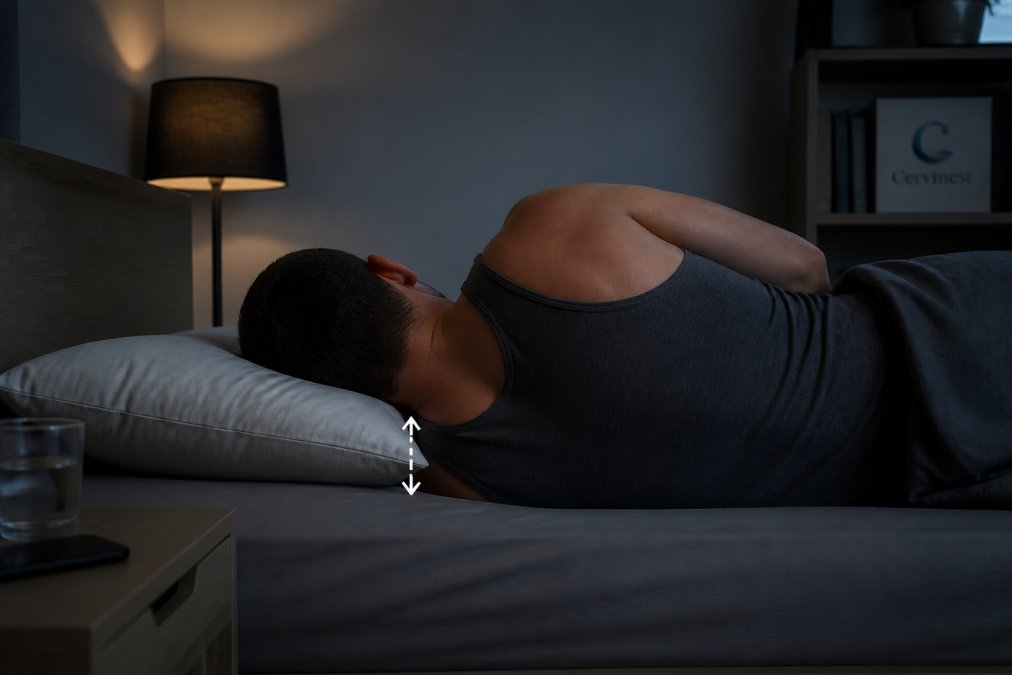
A side sleeper pillow for broad shoulders solves a problem most pillows were never designed to handle: the shoulder gap, which is why choosing the right side sleeper pillow matters so much. When you lie on your side, your shoulder creates a gap between your head and the mattress that standard pillows simply cannot fill. This gap forces your neck to tilt downward or upward for hours, straining muscles and joints.
Standard pillows are built for back sleepers. They compress under the weight of your head and offer no structural support for your neck. For someone with wider shoulders, the problem compounds. The wider your shoulders, the deeper the gap your pillow needs to fill.
Here's what most guides get wrong: they recommend "firmer" pillows without addressing loft height. Firmness matters, but height determines whether your cervical spine stays neutral. Get the height wrong, and even the best materials won't help.
Below, we'll show you exactly how to calculate your ideal loft height and match it to your body and mattress.
Pillow Loft for Side Sleepers: Finding the Right Height
Pillow loft for side sleepers is the single most important measurement you'll take. Loft refers to the height of the pillow when it's resting on your mattress under the weight of your head, not when you're holding it in a store. A pillow that measures 6 inches on the shelf may compress to 3 inches once you lie down, which is why manufacturer specs alone won't tell you whether a pillow will work for broad shoulders.
For broad-shouldered side sleepers, the ideal compressed loft typically ranges from 10 to 15 centimeters (4 to 6 inches). That's significantly higher than the 7 to 10 centimeters (3 to 4 inches) most standard pillows offer after compression.
Proper spinal alignment during sleep reduces morning stiffness and supports long-term spinal health. Your pillow's job is to keep your head, neck, and spine in one straight line.
How Loft Height Affects Cervical Alignment
Cervical alignment refers to the natural curve of your neck when your spine is in a neutral position. When your pillow is too low, your head drops below your spine's natural line, stretching neck muscles all night. When it's too high, your chin tucks toward your chest, compressing the cervical spine.
Both positions cause morning stiffness, tension headaches, and shoulder blade pressure. The right loft height keeps your head level with your spine, allowing muscles to relax completely.
A simple test: lie on your side and have someone check if your nose aligns with the center of your chest. If it points up or down, your pillow height is wrong.
A Repeatable Way to Calculate Your Target Loft
Most guides stop at a range and leave you guessing. Here's a calculation you can run in a minute using two measurements you already have.
- Measure your shoulder width (see the next section for the method).
- Measure your mattress sinkage. Lie on your side on your bare mattress and have someone measure the vertical distance from the mattress surface to the tip of your shoulder. On a firm mattress this is often 3 to 4 inches; on a plush or memory foam mattress it can drop to 1.5 to 2.5 inches because your body sinks in.
- Add a 1 to 2 inch cushion for head comfort. Your head should rest on top of the pillow, not be propped up by it.
Target compressed loft = shoulder-to-mattress gap + 1 to 2 inches of head cushion.
A broad-shouldered sleeper on a firm mattress might land at 5 to 6 inches of compressed loft. The same sleeper on a soft mattress might need only 3.5 to 4.5 inches, because the mattress is already doing part of the gap-filling work.
Why "High Loft" Labels Are Misleading
A pillow marketed as "high loft" may still be too short for you once it compresses. Two pillows can both claim 6 inches of loft, but a low-density memory foam pillow may lose 50 percent of its height under a 10-pound head, while a high-density foam or latex pillow may lose only 20 to 30 percent. That's the difference between a pillow that works at 2 a.m. and one that has flattened by midnight.
When you shop, look for two numbers if the brand publishes them: the uncompressed loft and the compressed loft (sometimes listed as "loft under load"). If only the uncompressed number is available, assume a 30 to 50 percent loss for memory foam and 20 to 30 percent for latex or high-density foam.
Matching Loft to Mattress Firmness
Your mattress firmness changes everything. A soft mattress lets your body sink deeper, which reduces the shoulder gap and calls for slightly less loft. A firm mattress keeps your body higher, requiring more pillow height to fill the gap.
The rule of thumb: add 1 to 2 centimeters of loft for a firm mattress, subtract 1 to 2 centimeters for a soft one. This pillow-to-mattress firmness synergy is the detail most buying guides skip entirely.
A quick way to sanity-check your mattress category:
- Firm: You don't sink in when you sit down, and your hips and shoulders stay level with your spine when lying on your side.
- Medium: You sink in 1 to 2 inches when sitting, and your spine stays roughly straight on your side.
- Soft/plush: You sink in more than 2 inches when sitting, and your hips may dip below your shoulders on your side.
If you're between two loft sizes, size up. It's easier to remove fill or fold a pillow down than to add height to one that's too flat.
How to Measure Shoulder Width for Pillow Height
Learning how to measure shoulder width for pillow height takes about two minutes and eliminates all guesswork. You'll need a soft tape measure and a wall.
Stand against the wall with your shoulders relaxed. Measure from the outermost point of one shoulder to the outermost point of the other, across your back. This is your shoulder width.
Now match your measurement to a loft range:
| Shoulder Width | Recommended Loft (Compressed) | Pillow Type |
|---|---|---|
| Under 40 cm (16 in) | 7-10 cm (3-4 in) | Low-loft |
| 40-48 cm (16-19 in) | 10-13 cm (4-5 in) | Medium-loft |
| Over 48 cm (19 in) | 13-15 cm (5-6 in) | High-loft |
Matching Loft to Mattress Firmness
Your mattress firmness changes everything. A soft mattress lets your body sink deeper, which reduces the shoulder gap and calls for slightly less loft. A firm mattress keeps your body higher, requiring more pillow height to fill the gap.
The rule of thumb: add 1-2 centimeters of loft for a firm mattress, subtract 1-2 centimeters for a soft one. This pillow-to-mattress firmness synergy is the detail most buying guides skip entirely.
Cervical Pillow for Shoulder Pain: What to Look For
A cervical pillow for shoulder pain must do three things: fill the shoulder gap, support the neck's natural curve, and distribute pressure evenly across your shoulders and head. Most guides stop there and hand you a feature list. The sections below go further, covering the three things the top-ranking articles consistently miss.
The Basics: Features That Actually Matter
Look for these features:
- Adjustable fill or height: Lets you fine-tune loft without buying a new pillow. Zippered covers with removable foam, shredded latex, or water chambers all qualify.
- Contoured design: A raised edge supports the cervical curve while the center cradles your head. The raised edge should be roughly 1 to 2 inches higher than the center.
- Firm support that doesn't collapse: Memory foam with a density of at least 3 pounds per cubic foot holds its shape longer than low-density alternatives. Latex is denser still and rebounds faster.
- Breathable materials: Covered in detail below, because this is where most high-loft pillows fail.
What most guides miss: the pillow needs to work with your body mechanics, not against them. A pillow that's too firm creates new pressure points. One that's too soft collapses by morning.
Gap 1: Temperature Regulation for High-Loft Pillows
High-loft pillows trap heat. A 5- to 6-inch pillow puts more foam between you and airflow, and traditional memory foam is closed-cell by nature, meaning it holds your body heat instead of releasing it. Broad-shouldered sleepers often run warm anyway because more body surface is in contact with the mattress and pillow.
If you wake up with a sweaty neck or flip your pillow to the cool side three times a night, the pillow is working against your sleep. Here's what actually helps, ranked by effectiveness:
- Open-cell or gel-infused foam: Open-cell foam has a more porous structure that lets air move through it. Gel infusions add conductive material that pulls heat away from the surface. Both are meaningful upgrades over standard memory foam.
- Phase-change materials (PCMs): These absorb and release heat at a set temperature, similar to how a cold pack works. They're common in premium pillows and mattress covers.
- Shredded latex or shredded foam: Loose fill allows more airflow than a solid block, though it compresses differently and may need re-fluffing.
- Breathable covers: A bamboo viscose, Tencel, or moisture-wicking polyester cover makes a noticeable difference even on a warm pillow. Avoid tightly woven cotton or synthetic blends that trap moisture.
A simple test: press your palm into the pillow for 30 seconds. If the spot feels noticeably warm when you lift your hand, the foam is holding heat. If it feels close to room temperature, airflow is better.
Gap 2: Physical Therapy Exercises That Complement Your Pillow
A pillow can only do so much. If you've had shoulder or neck pain for more than a few weeks, the muscles around your cervical spine and shoulder blades are likely tight and weak in ways a pillow can't fix overnight. A pillow supports alignment; it doesn't strengthen the muscles that hold that alignment during the day.

Consider these commonly recommended movements, and check with a physical therapist before starting if you have an injury:
- Chin tucks: Sit or stand tall, pull your chin straight back (not down) as if making a double chin, hold for 5 seconds, repeat 10 times. This counters forward head posture.
- Doorway chest stretch: Place your forearms on either side of a doorway at shoulder height, step through gently, and hold for 30 seconds. This opens the chest and reduces the pull that rounds your shoulders forward.
- Scapular squeezes: Squeeze your shoulder blades together as if holding a pencil between them, hold for 5 seconds, repeat 10 times. This strengthens the muscles that support shoulder blade position.
- Side-lying thoracic rotation: Lie on your side with knees bent, extend your top arm, and rotate your chest open toward the ceiling. Hold for 30 seconds per side. This mobilizes the mid-back, which affects how your neck sits on a pillow.
A common pattern is 5 to 10 minutes in the morning and again before bed. The goal isn't intensity; it's consistency.
Gap 3: Budget-Friendly DIY Loft Adjustments
Before you buy a new pillow, try modifying what you already own. This is the cheapest way to test whether a higher loft actually helps you, and it's a step almost no buying guide mentions.
- Towel stacking: Fold bath towels to your target height and slide them under your current pillow. This is the fastest way to simulate a higher-loft pillow without spending anything.
- Pillow stacking: Two medium pillows stacked often land in the 5- to 6-inch compressed range. The downside is that stacked pillows can shift apart during the night.
- Fill removal or addition: If your pillow has a zippered cover, you can remove foam or shredded fill to lower the loft, or add shredded memory foam (sold separately in craft and bedding stores) to raise it. Start with small additions and test for two nights.
- Pillow wedges: A foam wedge placed under your pillow raises the whole sleep surface without changing the pillow itself. This is useful if you want to keep a pillow you already like.
- Mattress topper adjustment: If your mattress is very firm, a 2-inch soft topper can reduce the shoulder gap and let you use a lower-loft pillow you already own.
Putting It Together
The pillow is one part of the system. Pair a properly fitted high-loft pillow with a cool-sleeping cover, a short daily mobility routine, and a mattress that matches your body's sinkage, and you address the problem from every angle instead of hoping one product solves it alone.
Cervinest Cervical Neck Pillow with Water Base: Best Adjustable Support
The Cervinest Cervical Neck Pillow with Water Base is our top pick for broad-shouldered side sleepers because it solves the adjustability problem directly. A built-in water chamber lets you add or remove water to set your exact loft height. No guessing, no returns.

The water base adapts to your movements through the night, keeping your head and neck supported as you shift positions. The gentle water pressure maintains your neck's natural curvature while easing built-up tension.
What works: Full control over firmness and height in one pillow. The water chamber responds to your body instead of forcing your body to adapt to it.
Cervinest Orthopedic Pillow for Neck Pain: Best Value
The Cervinest Orthopedic Pillow for Neck Pain delivers ergonomic cervical alignment at $44.99, making it the most affordable option in this lineup. It restores natural neck posture and cushions both side and back sleepers.

Cervinest Pillow for Neck and Shoulder Pain: Best for Chronic Tension
The Cervinest Pillow for Neck and Shoulder Pain targets the specific combination of neck and shoulder tension that broad-shouldered side sleepers know well. At $94.99, it's built for people whose discomfort has followed them for months or years.
Cervinest Neck Support Pillow: Best for Tech Neck
The Cervinest Neck Support Pillow is built for the desk-worker problem: tech neck. At $104.99, it's the premium option, and it addresses the posture strain that accumulates during screen-heavy workdays.
Common Mistakes Broad-Shouldered Side Sleepers Make
Other common errors:
- Using a pillow past its lifespan: Most pillows lose their structural support within 18 to 24 months. If yours folds in half and stays folded, it's done.
- Ignoring mattress firmness: A pillow that works on a soft mattress may fail on a firm one. Match both.
- Skipping the transition period: New pillows take one to two weeks to adjust to. Give your body time before deciding it doesn't work.
- Sleeping without shoulder support: If your shoulder aches along with your neck, your pillow isn't filling the gap completely.
If mornings still bring stiffness after two weeks with a properly fitted pillow, it's worth talking to a physical therapist about strengthening exercises for the muscles that support your neck and shoulders.
Frequently Asked Questions
What is the best pillow for people with broad shoulders who sleep on the side?
The best side sleeper pillow for broad shoulders has enough loft to fill the gap between your neck and the mattress, keeping your cervical spine neutral. Look for a pillow with adjustable fill or a water chamber so you can fine-tune the height. A pillow that is too flat lets your head drop, straining your neck; one that is too high pushes your chin down. Adjustable options let you match the loft to your exact shoulder width and mattress firmness.
How does shoulder width affect pillow selection for side sleepers?
Shoulder width determines how far your head sits from the mattress when you lie on your side. Broader shoulders create a larger gap, requiring a higher loft to keep your head and neck aligned with your spine. If the pillow is too low, your head tilts down and your neck bends, leading to morning stiffness. Measuring from the base of your neck to the outer edge of your shoulder gives you a starting point for choosing the right loft height.
Can the wrong pillow cause shoulder pain for broad-shouldered individuals?
Yes. When a pillow is too flat, your head drops and your shoulder rolls forward, putting pressure on the shoulder joint and surrounding muscles. Over time, this misalignment can cause shoulder blade pressure, numbness, and chronic tension. A pillow with firm support and the right loft keeps your head level with your spine, reducing pressure points and allowing your shoulder to rest in a neutral position throughout the night.
Do I need a firmer pillow if I have broad shoulders?
Not necessarily firmer, but you do need one that holds its loft without collapsing. Broad-shouldered side sleepers benefit from a pillow with enough structural support to maintain height under the weight of the head. Memory foam with high density or a water-based chamber provides consistent support. A soft down pillow may feel comfortable at first but flattens quickly, leaving your neck unsupported by morning.
What materials provide the best support for wide-shouldered side sleepers?
Memory foam, latex, and water-based chambers offer the most consistent support for wide-shouldered side sleepers. Memory foam conforms to your neck curve and holds its shape, while latex is more responsive and breathable. Water-based pillows let you adjust the fill level for personalized loft height. Avoid down or low-density fiberfill if you need firm support, as these materials compress under weight and lose loft over time.