
How to Fix Tech Neck Posture: A Complete Guide
Table of Contents
- What Is Tech Neck and Why It Matters
- Understanding the Root Causes of Tech Neck
- How to Improve Forward Head Posture at Your Desk
- Tech Neck Exercises for Pain Relief That Work
- Best Pillows for Cervical Spine Alignment During Sleep
- Sleep Posture Adjustments to Support Spinal Health
- Movement Breaks and Postural Habits That Prevent Tech Neck
- When to Seek Professional Help for Persistent Neck Pain
- Frequently Asked Questions
Last Updated: September 18, 2026
What Is Tech Neck and Why It Matters
Tech neck is the forward head posture that develops from spending hours bent over phones, tablets, and computer screens. Your head shifts forward, pulling your cervical spine out of alignment. This isn't just discomfort, it's a biomechanical problem that compounds over time.
When your head leans forward, your neck muscles work overtime to support the extra weight. The average human head weighs 10-12 pounds. Tilt it forward 15 degrees and your neck feels 27 pounds of pressure. At 45 degrees, it's 49 pounds. Many office workers spend six to eight hours daily in this position.
The result is chronic tension, stiffness, and often pain that follows you from your desk straight into bed. This is where you need to fix tech neck posture, not just for comfort, but for your long-term spinal health.
At Cervinest, we understand how pervasive this problem has become. Office workers, students, and frequent travelers all report the same complaint: neck pain that won't quit. The good news is that tech neck is preventable and reversible with the right approach.

Understanding the Root Causes of Tech Neck
Tech neck develops from a combination of habits and environmental factors, but the root cause differs significantly depending on whether you're primarily a smartphone user or a desk worker. Understanding this distinction helps you target the right fixes.
Smartphone Neck vs. Workstation Neck
Smartphone neck occurs when you hold a device below eye level and look down. This creates a forward head posture of 15-45 degrees depending on how far below eye level you hold the phone. The problem compounds because most people hold phones for extended periods without breaks, studies show the average person checks their phone 96 times per day, often in downward-looking positions. Over months, this repetitive downward gaze trains your cervical spine into a forward position even when you're not holding the phone.
Workstation neck develops differently. A monitor positioned too low, a chair that doesn't support your lumbar spine, or a keyboard placed too high forces your head forward to maintain visual focus. Unlike smartphone use, which is intermittent, workstation posture is sustained for 6-8 hours daily. The continuous load on your cervical spine creates a different injury pattern: your deep cervical flexors weaken from disuse while your upper trapezius and posterior neck muscles become chronically overactive and fatigued.
The Biomechanical Cascade
When your head moves forward, your cervical spine doesn't just tilt, it triggers a chain reaction throughout your body. Your head weighs 10-12 pounds in neutral position. At 15 degrees forward, your neck experiences 27 pounds of force. At 45 degrees (common with smartphone use), it's 49 pounds. This isn't just pressure; it's sustained tension on muscles, ligaments, and discs.
This sustained forward position causes your deep cervical flexors (the longus colli and longus capitis muscles) to lengthen and weaken. Simultaneously, your upper trapezius, levator scapulae, and neck extensors shorten and become hypertonic. This muscle imbalance is self-perpetuating: weak deep flexors can't support your head properly, so your overactive extensors work harder to compensate, creating more tension and fatigue.
Environmental and Postural Risk Factors
Your workstation setup directly determines whether you develop tech neck. If your monitor sits below eye level, you'll crane forward. If it's too far away (beyond 26 inches), you'll lean in. If your chair doesn't support your lower back's natural curve, your entire spine compensates by shifting forward. Poor lumbar support is one of the most overlooked causes, when your lower back rounds, your cervical spine follows, amplifying forward head posture.
Sedentary behavior amplifies all of these factors. Sitting without movement for hours allows muscles to tighten and shorten. Your proprioception (body awareness) deteriorates, making it harder to maintain good posture even when you try. Movement breaks interrupt this cycle, but most office workers take fewer than two breaks per hour.
Sleep Posture as a Compounding Factor
Many people don't realize that poor sleep posture undermines daytime fixes. If your pillow doesn't support your cervical spine, your neck spends 6-8 hours in a compromised position every night. A pillow that's too thin leaves a gap between your neck and the mattress, forcing your neck muscles to work while you sleep. A pillow that's too thick tilts your head backward, creating strain on the posterior cervical spine. You wake up stiff and tense, then repeat the forward-head pattern at work. This cycle, poor sleep posture at night, forward head posture during the day, accelerates the development of chronic tech neck.
Understanding which cause applies to you is essential. A smartphone user needs different fixes than a desk worker. Both need to address sleep posture. And both need to understand that tech neck isn't just a posture problem, it's a muscle imbalance problem that develops over weeks and months of repetitive strain.
How to Improve Forward Head Posture at Your Desk
Start with your workstation. Your monitor should be at eye level when you sit with your shoulders relaxed and your back against the chair. The top of the screen should be at or slightly below eye height. Position it about an arm's length away, roughly 20-26 inches.
Your keyboard and mouse should sit at elbow height. When your arms rest at your sides with elbows bent at 90 degrees, your hands should align with the keyboard. This prevents you from hunching forward to reach.
Invest in an ergonomic chair that supports your lower back and maintains the natural curve of your lumbar spine. Your feet should rest flat on the floor or a footrest. Your thighs should be parallel to the ground.
Even with perfect setup, you need to move. Sedentary posture, no matter how correct, creates problems. Stand and stretch every 30 minutes. Walk for two minutes. Roll your shoulders backward. These brief breaks reset your posture and prevent muscle fatigue.
Tech Neck Exercises for Pain Relief That Work
The right exercises address the muscle imbalances that create tech neck. These aren't random stretches; they target the specific areas that suffer from forward head posture. Critically, the exercises you do depend on whether you're managing acute pain or building long-term prevention.
Chin Tucks and Deep Cervical Flexor Strengthening
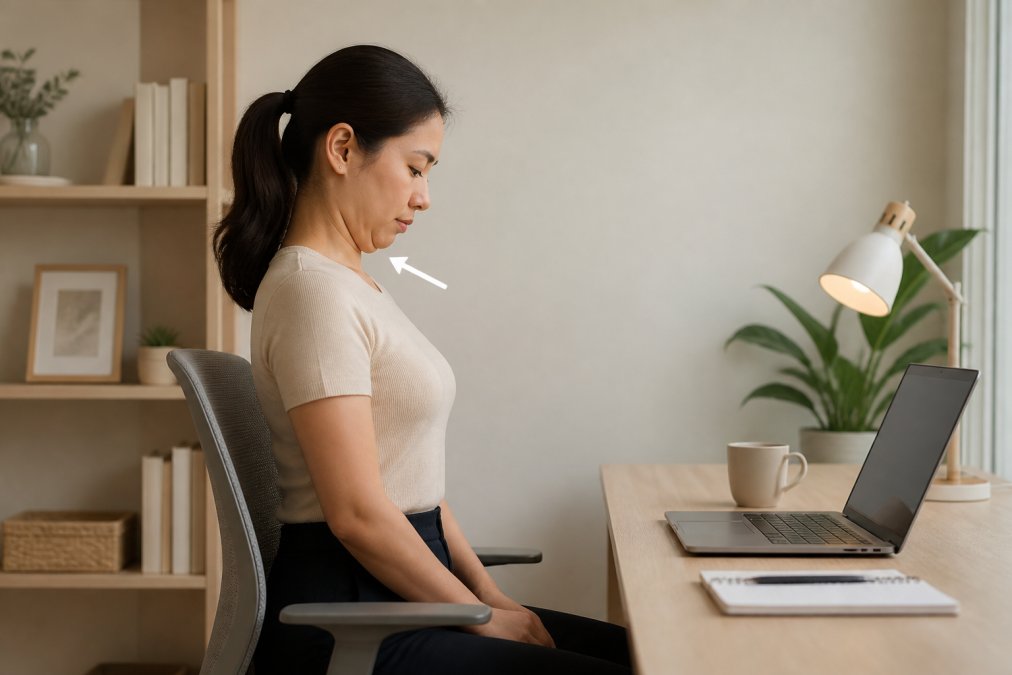
Chin tucks strengthen your deep neck flexors (longus colli and longus capitis), the muscles responsible for supporting your cervical spine against forward head posture. These muscles are often completely inactive in people with tech neck, which is why retraining them is essential.
Basic chin tuck (foundational):
- Sit or stand with your shoulders relaxed and your gaze forward
- Draw your chin straight back, as if making a double chin
- Hold for two seconds
- Release and repeat
- Perform three sets of 10 repetitions, twice daily
This exercise feels awkward at first because your muscles are unused to the activation. That awkwardness means you're working the right muscles. Many people perform chin tucks incorrectly by tilting their head up or down instead of moving purely backward. Keep your gaze level throughout.
Progression: Isometric chin tuck with resistance (intermediate): Once basic chin tucks feel easy (usually after 2-3 weeks), add resistance. Place your index and middle finger on your chin and apply gentle forward pressure while you perform the chin tuck. Your chin moves backward against your finger resistance. This increases muscle activation without adding external weight.
Progression: Supine chin tuck with head lift (advanced): Lie on your back with your knees bent and feet flat on the floor. Perform a chin tuck, then lift your head 2-3 inches off the floor while maintaining the tucked position. Hold for five seconds. This challenges your deep flexors against gravity. Perform three sets of eight repetitions, three times per week.
Consistency matters more than intensity. Daily chin tucks for four weeks will produce noticeable improvement in posture and pain reduction. Most practitioners find that people who do chin tucks twice daily see results within 2-3 weeks.
Scapular Retraction and Upper Back Stabilization
Your shoulder blades (scapulae) are foundational to neck health. When they're positioned correctly, your entire upper back supports proper cervical alignment. Scapular retraction strengthens the rhomboids and middle trapezius, muscles that have usually weakened from forward posture.
Basic scapular retraction (foundational):
- Sit upright with arms at your sides
- Squeeze your shoulder blades together as if trying to hold a pencil between them
- Hold for three seconds
- Release slowly
- Perform three sets of 12 repetitions, daily
The movement should be controlled and deliberate. Many people shrug their shoulders upward instead of retracting them backward. Keep your shoulders down and pull your blades toward your spine.
Progression: Scapular retraction with resistance band (intermediate): Loop a resistance band around a sturdy object at chest height. Hold the band with both hands, arms extended. Pull the band toward your chest by retracting your shoulder blades. Hold for two seconds. Perform three sets of 12 repetitions, three times per week.
Progression: Prone Y-T-W raises (advanced): Lie face-down on an incline bench or stability ball. Perform three movements in sequence: Y (arms overhead at 45 degrees), T (arms out to the sides), and W (arms bent at 90 degrees, elbows at shoulder height). Each position targets different scapular muscles. Perform five repetitions of each position, three times per week.
Stretching Routines for Neck Relief and Muscle Release
Stretching releases tension in the muscles that tighten from tech neck. These stretches target your upper trapezius, levator scapulae, and sternocleidomastoid muscles, the muscles most overactive in forward head posture.
Upper trapezius stretch:
- Sit upright
- Tilt your right ear toward your right shoulder
- Use your right hand to gently increase the stretch by applying light pressure to the left side of your head
- Hold for 20-30 seconds
- Repeat on the left side
- Perform three sets per side, twice daily
You should feel a gentle stretch along the side of your neck, not sharp pain. Never bounce or force the stretch.
Levator scapulae stretch:
- Sit upright
- Tilt your right ear toward your right shoulder
- Rotate your head 45 degrees downward (looking toward your right armpit)
- Use your right hand to gently increase the stretch
- Hold for 20-30 seconds
- Repeat on the left side
- Perform three sets per side, twice daily
This targets the levator scapulae, a muscle that directly connects your neck to your shoulder blade and is chronically tight in tech neck sufferers.
Doorway chest and shoulder stretch:
- Stand in a doorway with your right arm raised to 90 degrees, forearm against the doorframe
- Step forward until you feel a stretch across your chest and front shoulder
- Hold for 20-30 seconds
- Repeat on the left side
- Perform three sets per side, once daily
This stretch addresses the pectoralis major and minor, muscles that tighten from forward posture and pull your shoulders forward.
Exercise Frequency and Progression Timeline
For acute pain (current neck pain or stiffness), perform chin tucks and stretches twice daily for the first two weeks. Add scapular retractions in week three. Progress to intermediate exercises in week four if pain has decreased by at least 50 percent.
For prevention (no current pain but concerned about tech neck), perform all three exercise categories three times per week. This maintains muscle balance and prevents the forward head posture pattern from developing.
Most people notice improvement within 2-3 weeks of consistent exercise. Significant postural change typically takes 6-8 weeks. If pain persists beyond four weeks despite consistent exercise, consult a physical therapist for assessment.
Best Pillows for Cervical Spine Alignment During Sleep
Your pillow is either supporting or sabotaging your cervical spine every single night. A poor pillow leaves a gap between your neck and the mattress, forcing muscles to work while you sleep. The right pillow fills that gap and maintains the natural curve of your cervical spine.
Look for pillows with firm support that doesn't compress flat. Memory foam that bottoms out within weeks won't help you. Your pillow should cradle your head while keeping your neck in neutral alignment, not tilted forward or backward.
Cervinest's Orthopedic Pillow for Neck Pain is designed specifically for this. It preserves natural alignment and helps fill the gap between your neck and mattress. The firm support prevents tossing and turning, and the fresh design means no chemical odor on day one.
For side sleepers with broader shoulders, the Cervical Neck Pillow with Water Base offers customizable support. You control the firmness by adding or removing water. This adapts to your exact body type and sleeping position.

Sleep Posture Adjustments to Support Spinal Health
Your sleeping position determines whether your cervical spine gets eight hours of recovery or eight hours of strain. Back sleeping is generally best for spinal alignment. Your head, neck, and spine form a straight line. Use a pillow that supports this alignment without tilting your head back.
Side sleeping is acceptable if you use proper support. Your pillow should be thick enough to keep your head aligned with your spine. If your pillow is too thin, your head tilts down. If it's too thick, your head tilts up. Both create strain.
Never sleep on your stomach. This position forces your head to turn 90 degrees, twisting your cervical spine for hours. Even one night in this position creates stiffness.
Invest in a pillow designed for cervical support. The Neck Support Pillow for Pain Relief provides firm bracing for your neck while cradling your head. The supportive wedge extension reduces stiffness and helps you wake up refreshed instead of stiff.

For travelers, the Pillow for Neck and Shoulder Pain offers portable support. Whether you sleep on your side or back, it maintains natural alignment and prevents the neck pain that travel often triggers.
Movement Breaks and Postural Habits That Prevent Tech Neck
Prevention is simpler than recovery. Small habits compound into major changes. Set a timer for every 30 minutes. When it goes off, stand up. Walk. Stretch. Move your neck through its full range of motion.
Neck rolls help maintain mobility. Slowly roll your head in circles, five circles forward, five circles backward. Do this twice daily. This keeps your neck flexible and prevents the stiffness that develops from static posture.
Be intentional about how you use your phone. Hold it at eye level instead of looking down. This single change eliminates the forward head posture that phones create. If you're on your phone for two hours daily, this matters.
Take posture breaks during work. Every hour, stand and do five minutes of the exercises mentioned above. This resets your muscles and prevents the cumulative fatigue that leads to pain.
When to Seek Professional Help for Persistent Neck Pain
If you've been working to fix tech neck posture through exercise, ergonomics, and proper sleep support for four weeks and pain persists, consult a physical therapist or healthcare provider. Persistent pain may indicate something beyond postural strain.
Red flags that warrant professional evaluation include:
- Sharp pain that radiates down your arm
- Numbness or tingling in your hands
- Weakness in your arms or hands
- Pain that wakes you from sleep despite proper pillow support
- Stiffness that doesn't improve with stretching
A physical therapist can assess your specific posture and muscle imbalances. They'll design exercises tailored to your needs. Many insurance plans cover physical therapy when referred by a doctor.
Tech neck doesn't develop overnight, and it doesn't disappear overnight either. But with consistent attention to ergonomics, targeted exercises, and proper sleep support, you can reverse it. Start with your workstation setup. Add the exercises. Then prioritize sleep with a pillow that supports your cervical spine. Cervinest's cervical pillows are designed to fill the gap between your neck and mattress while cradling your head in natural alignment. Get started with Cervinest and wake up without the neck tension that's been holding you back.
Frequently Asked Questions
How long does it take to fix tech neck posture?
Most people notice improvement in neck stiffness and tension within 2-4 weeks of consistent ergonomic adjustments, targeted exercises, and proper sleep support. However, correcting forward head posture fully—where your cervical spine realigns and muscle imbalances resolve—typically takes 6-12 weeks of sustained effort. Severe cases may require 3-6 months. The key is consistency: daily posture awareness, regular stretching, and nighttime cervical spine support through a proper pillow make the difference between temporary relief and lasting change.
What are the best exercises to fix tech neck?
Chin tucks, scapular retractions, and targeted neck stretches form the foundation of tech neck recovery. Chin tucks strengthen your deep neck flexors and counteract forward head posture by retraining your cervical spine alignment. Scapular retractions engage your rhomboids and trapezius, correcting the rounded shoulder posture that pulls your head forward. Gentle stretching of your upper trapezius and levator scapulae releases tension built up during the day. Perform chin tucks for 2 sets of 15 reps daily, scapular retractions for 3 sets of 10, and hold neck stretches for 30 seconds on each side, 2-3 times daily.
Can tech neck be corrected permanently?
Yes, tech neck posture can be corrected permanently if you address both the daytime habits and nighttime support. Permanent correction requires three elements: (1) ergonomic workstation adjustments so your monitor is at eye level and your cervical spine stays neutral during work, (2) consistent exercises that rebuild proper muscle balance and postural alignment, and (3) sleep support through a cervical pillow that maintains natural neck curvature overnight. Without all three, you may experience temporary relief but revert to forward head posture. The Cervical Neck Pillow with Water Base ($59.99) or Neck Support Pillow ($104.99) provides the nighttime foundation that prevents tension from rebuilding while you sleep.
Does sleeping position affect tech neck recovery?
Absolutely. Your sleeping position directly impacts whether your cervical spine can recover or whether tension rebuilds overnight. Back sleeping works with a pillow that fills the gap between your neck and the mattress, maintaining your cervical curve. Side sleeping with proper pillow support keeps your head aligned with your spine. Stomach sleeping forces your cervical spine into rotation and should be avoided entirely during recovery. The right pillow is essential: it must cradle your head and support the natural curve of your neck so your muscles can truly relax and tension can release.