
Sleep Posture for Neck Health: The Complete 2026 Guide
Table of Contents
- Why Sleep Posture Matters for Neck Health
- Best Sleeping Position for Neck Pain
- Sleeping on Your Stomach and Neck Pain
- Pillow Height for Neck Alignment
- How to Fix Bad Neck Posture While Sleeping
- Keeping the Head and Neck in Neutral Position
- Transitioning Away from Stomach Sleeping
- Red Flags: When Neck Pain Requires Professional Care
- What the Research Actually Shows About Sleep Position
- Practical Steps to Optimize Your Sleep Setup
- Frequently Asked Questions
Last Updated: October 5, 2026
Why Sleep Posture Matters for Neck Health
The position you sleep in affects your neck more than you might realize.
Most people don't think about sleep posture until pain forces them to. By then, they've spent months or years training their body into a harmful pattern.
Best Sleeping Position for Neck Pain
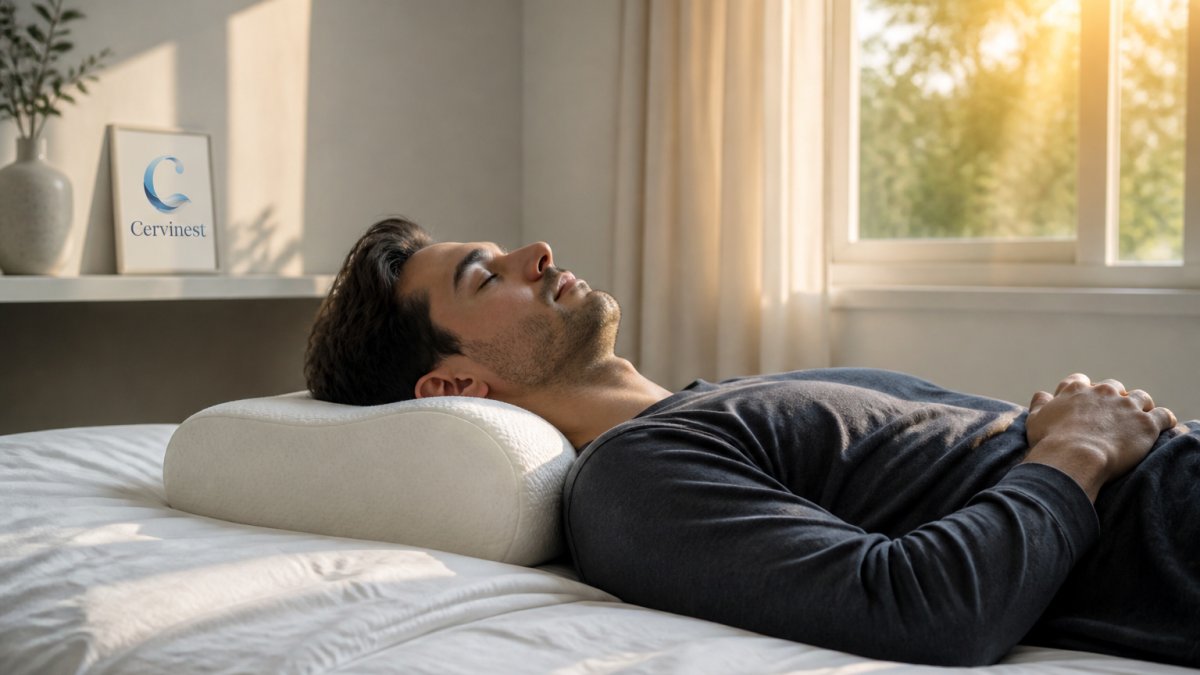
The best sleeping position for neck pain is back sleeping, when done correctly.
That said, back sleeping only works if your pillow height and mattress firmness support neutral alignment. A pillow that's too high pushes your chin toward your chest.
The second-best option for sleep posture for neck health is side sleeping, but it requires precision. Your pillow must fill the gap between your shoulder and head completely.
Stomach sleeping is the most problematic position for neck health. It forces your cervical spine into extreme rotation for 6-8 hours straight.
Back Sleeping and Neutral Spinal Alignment
Back sleeping positions your spine in its most natural state.
The mechanics are straightforward: when you lie on your back, your neck's natural curve (called cervical lordosis) is preserved. Your head doesn't tilt forward or backward. Your shoulders stay relaxed.
The challenge most people face is finding a pillow that actually maintains this alignment. A standard pillow designed for stomach sleepers is usually too thick.
For back sleeping to work for sleep posture for neck health, your pillow should support the curve of your neck without pushing your head forward.
Side Sleeping and Head-to-Neck Alignment
Side sleeping is viable for sleep posture for neck health, but it's where most people go wrong.
When you sleep on your side, the distance between your ear and shoulder is larger than it is when you're on your back.
The fix requires a pillow with higher loft, the measurement of how thick the pillow is when compressed under your head.
Beyond pillow height, your mattress firmness matters more for side sleeping. A mattress that's too soft lets your shoulder sink in, which increases the gap between shoulder and head.
The Orthopedic Pillow for Neck Pain at Cervinest provides contoured support that adapts to side sleeping, maintaining proper head-to-neck alignment without the constant adjusting most side sleepers experience through the night.

Sleeping on Your Stomach and Neck Pain
Stomach sleeping is the most harmful position for your cervical spine. It forces extreme rotation that no pillow can fully correct.
This position creates a cascade of problems. The rotation compresses your cervical discs. Muscles on the compressed side shorten and tighten.
Many chronic stomach sleepers don't realize their position is the source of their pain.
If you've been a stomach sleeper for years, transitioning away feels impossible at first. Your body is conditioned to that position.
The key to transitioning is not forcing yourself to stay in a new position all night.
Pillow Height for Neck Alignment
Pillow height, called loft in the industry, is the single most important factor in sleep posture for neck health. Get this wrong and even the best sleeping position won't help.
Your pillow's job is to fill the gap between your neck and the mattress while keeping your head level with your spine.
The correct pillow height depends on three factors: your sleeping position, your shoulder width, and your mattress firmness.
Most people buy pillows based on feel alone. They squeeze it in the store, it feels comfortable, and they take it home.
Finding Your Ideal Pillow Loft
The self-check method works: lie on your side on your mattress and have someone measure the distance from the top of your shoulder to your ear.
For back sleeping, measure the distance from the base of your neck to the back of your head.
In practice, most people need a pillow with 4-6 inches of loft for side sleeping and 3-4 inches for back sleeping. But this varies significantly.
The Cervical Neck Pillow with Water Base from Cervinest solves this problem by letting you customize the loft. You add or remove water to match your exact needs.
Pillow Firmness and Support Levels
Firmness and loft are different things, and both matter for sleep posture for neck health. A pillow can be tall but soft, or short but firm.
Firmness determines how much your head sinks into the pillow.
Memory foam and gel-infused materials are popular because they conform to your head shape.
The Pillow for Neck and Shoulder Pain at Cervinest uses a contoured cervical design that provides targeted support where you need it most.

How to Fix Bad Neck Posture While Sleeping
Fixing sleep posture for neck health is a diagnostic process, not a single purchase. Most people with chronic morning neck pain have two or three problems stacked on top of each other: a position their cervical spine can't tolerate, a pillow that doesn't match that position, and a mattress that changes how much work the pillow has to do.
This section gives you a repeatable way to test your setup in your usual sleeping position, the same method a physical therapist or chiropractor would walk you through in an office visit, plus a sequence for changing one variable at a time.
The Alignment Self-Check (Do This in Your Usual Position)
Do this on your own mattress, in the position you actually fall asleep in, not the position you wish you slept in.
What you need: a phone with a camera, a wall or a partner to hold it, and about 10 minutes.
Step 1, Take a side-profile photo. Lie down as you normally would.
Step 2, Read the photo against three checkpoints.
- Ear-to-shoulder line. In a neutral position, an imaginary line drawn from your ear canal down to the tip of your shoulder should be roughly vertical when viewed from the side. If your ear sits forward of your shoulder, your head is in forward flexion, usually a pillow that's too thick or a mattress that's too soft. If your ear sits behind your shoulder, your head is tipping backward, usually a pillow that's too thin.
- Chin-to-chest angle. Your chin should be roughly level, not tucked toward your sternum and not lifted. A tucked chin means your cervical spine is flexed; a lifted chin means it's extended. Both load the same joints from opposite directions.
- Shoulder position. On your side, the shoulder closest to the mattress should be directly under your torso, not rolled forward or back. A rolled shoulder twists the thoracic spine and drags the neck with it.
Step 3, Run the 15-minute settle test. Lie in the position for 15 minutes without adjusting.
Step 4, Log the morning result. Rate morning neck stiffness on a 0-10 scale for three consecutive nights before changing anything. This is your baseline.
Position-Specific Fixes
If you sleep on your back. The most common problem is a pillow that's too thick, which pushes the chin toward the chest and flattens the cervical curve.
If you sleep on your side. The most common problem is a pillow that's too thin for your shoulder width, which lets the head drop toward the mattress.
If you sleep on your stomach. No pillow height fully corrects the rotation. The practical fix is to reduce the rotation as much as possible while you work on transitioning (see the transition section below).
Adjusting the Mattress and Sleep Environment
Mattress firmness changes how much lift your pillow has to provide.
A low-cost test: if you suspect your mattress is too soft, slide a piece of plywood or a firm camping pad between the mattress and the box spring for one week.
Room conditions. Most sleep medicine sources put the ideal bedroom temperature in the mid-60s Fahrenheit.
Sleep duration. Sleep deprivation lowers your pain threshold and increases muscle tension. If you're routinely sleeping 5-6 hours, no pillow change will fully resolve morning neck pain until you also address duration.
Change One Variable at a Time
If you change your pillow, your position, and your mattress in the same week, you won't know which one helped, or which one made things worse. A simple sequence:
- Pillow first. It's the cheapest and fastest variable to change. Give a new pillow 5-7 nights before judging it.
- Position second. If the pillow is right and you're still waking up stiff, the position is the next suspect. Give a position change 2-4 weeks.
- Mattress third. Only after pillow and position are settled does it make sense to spend money on a mattress.
Keep the 0-10 morning stiffness log running the whole time. Improvement that shows up on the log is real; improvement that only shows up in how you feel on a single good morning usually isn't.
Keeping the Head and Neck in Neutral Position
Neutral position is the goal of proper sleep posture for neck health.
In neutral position, your cervical vertebrae are stacked properly. Discs are evenly pressured. Muscles are relaxed. Nerves have space.
Achieving neutral position requires three things working together: the right sleeping position, the right pillow, and a mattress that supports your body weight evenly.
Many people think they need to stay in one position all night to maintain neutral alignment. That's not realistic. Most people move 10-15 times per night.
The best pillows for maintaining neutral position are ones that support your specific body type and sleeping position.
Transitioning Away from Stomach Sleeping
If you've been a stomach sleeper for years, your nervous system is conditioned to that position. Your body feels stable and secure on its stomach.
The transition takes 2-4 weeks for most people. Here's how to do it without forcing yourself into a position that feels wrong:
Start by spending 15 minutes before bed practicing your new position. Lie on your back or side with a pillow that supports proper alignment. Don't try to fall asleep yet. Just get your body used to the sensation.
Gradually extend the time you spend in the new position. After a week, you might be able to stay in it for 4-5 hours before naturally rolling over.
The key is not fighting your body. If you force yourself to stay in an uncomfortable position all night, you'll fail and go back to stomach sleeping.
Many people find that a pillow designed specifically for their new sleeping position makes the transition much faster. The Orthopedic Neck Support Pillow at Cervinest provides support for your neck in back or side sleeping, which can help reduce the discomfort that usually makes people revert to stomach sleeping.

Red Flags: When Neck Pain Requires Professional Care
Most neck pain from poor sleep posture for neck health may improve within 2-4 weeks of correcting your position and pillow. If your pain persists or worsens, or if you experience any of these symptoms, seek professional evaluation:
Numbness or tingling in your arms or hands suggests nerve compression. This requires medical assessment to rule out serious conditions.
Weakness in your arms or hands is a sign that nerves are being significantly compressed. Do not attempt to self-treat this.
Pain that radiates down your arm in a specific pattern (not just general shoulder tension) indicates possible nerve involvement.
Dizziness or vertigo related to neck position can signal issues with blood flow or inner ear involvement.
Neck pain that wakes you up multiple times per night despite having a supportive pillow suggests something beyond sleep posture needs attention.
Any neck pain that follows an injury or trauma should be evaluated professionally, even if it seems minor.
What the Research Actually Shows About Sleep Position
Most articles on sleep posture for neck health present the back-is-best, stomach-is-worst hierarchy as settled science. It isn't. The evidence is directionally consistent but methodologically thin, and understanding what the research can and can't tell you will help you interpret your own results, and know when to stop blaming your pillow.
What the Evidence Supports Reasonably Well
Stomach sleeping is associated with more neck pain than back or side sleeping. This is the most consistent finding in the literature.
Pillow support interacts with sleeping position. Studies comparing contoured or position-specific pillows against flat pillows generally find better subjective outcomes, less morning stiffness, less waking with pain, for the position-matched pillow.
Neutral alignment is a reasonable biomechanical target. The recommendation to keep the head, neck, and spine in a straight line comes from biomechanics and ergonomics rather than from large clinical trials. It's a sound principle, but it's a principle, not a proven outcome.
What the Evidence Does Not Support
That one position is universally best. No study has shown that back sleeping is superior to side sleeping for all people, or that every stomach sleeper will develop neck pain.
That a specific pillow loft is optimal for everyone. The 4-6 inch side-sleeper range you'll see repeated online is a rough population average. It doesn't account for shoulder width, mattress compression, or head size.
That correcting sleep posture resolves chronic neck pain on its own. Sleep posture is one input among many, daytime posture, ergonomics, strength, stress, and underlying structural issues all contribute.
Why the Research Is Limited
A few structural problems run through most of this literature:
- Small samples. Many studies enroll a few dozen participants, which limits statistical power and makes it hard to generalize.
- Short duration. Most trials run for days to a few weeks. Chronic neck pain develops over months and years, so short trials can't capture long-term effects.
- Self-reported outcomes. Pain and stiffness are usually measured by asking participants how they feel, not by objective imaging or biomechanical measurement. Self-report is valid but sensitive to expectation.
- Unrepresentative pillows. Many studies use research-grade pillows that don't resemble what people actually buy, which limits how well the findings translate to your bedroom.
- Confounding. People who sleep on their backs may differ from stomach sleepers in ways that also affect neck pain, occupation, body type, exercise habits, and most studies can't fully control for that.
How to Read the Research for Your Own Situation
Given those limits, the most useful way to use the evidence is as a set of priors to test against your own experience:
- Start with the general hierarchy. Back or side sleeping is a better bet than stomach sleeping for most people. That's the strongest signal in the literature.
- Match the pillow to the position. The evidence for position-specific pillows is modest but consistent, and the intervention is cheap and low-risk.
- Run your own 2-4 week trial. Change one variable, log morning stiffness on a 0-10 scale, and compare. Your own data is more informative than any single study for your own body.
- Set a decision point. If a genuine 4-week trial of a corrected setup doesn't improve your morning symptoms, the problem is probably not sleep posture alone. That's when a clinician's evaluation is worth the visit.
This is also why you'll see conflicting advice across articles: one source emphasizes back sleeping, another side sleeping, another a specific pillow. They're often extrapolating from the same limited body of evidence in different directions. The honest position is that the general principles are well-supported, the specifics are not, and your individual response is the deciding factor.
Practical Steps to Optimize Your Sleep Setup
Start with one change at a time.
Week 1: Focus on pillow. Measure your ideal loft using the shoulder-to-ear method.
Week 2: Assess position.
Week 3: Evaluate mattress. If you're still experiencing morning stiffness, try the firmness adjustment test.
Week 4: Fine-tune. Adjust pillow loft if needed. Add support pillows for knees or between knees.
Track your morning experience each day. Rate your neck stiffness on a scale of 1-10.
The Orthopedic Pillow for Neck Pain at Cervinest is designed for this optimization process.
| Change | Expected Timeline | Success Indicator |
|---|---|---|
| Pillow replacement | 3-7 days | Reduced morning stiffness |
| Position transition | 2-4 weeks | Comfort in new position, less night-time adjusting |
| Mattress adjustment | 1-2 weeks | Less pressure point pain, better spinal alignment |
| Room environment | 3-5 days | Fewer position changes during night, better sleep quality |
The challenge isn't understanding what to do. According to research from the American Chiropractic Association, pillow support is the most modifiable factor in sleep ergonomics, and it's where most people see the fastest results.
Get started with Cervinest and wake up without neck tension.
Frequently Asked Questions
What is the best sleeping position for neck pain?
Back sleeping is generally the best position for neck pain because it allows your spine to maintain neutral alignment throughout the night. Your head, neck, and shoulders stay in a straight line, reducing strain on cervical structures. Side sleeping is the second-best option if your pillow height matches your shoulder width. Stomach sleeping should be avoided, as it forces your neck into rotation and forward flexion, aggravating pain.
How high should a pillow be to keep your neck aligned?
Pillow height depends on your sleeping position and shoulder width. A pillow that's too high pushes your head forward; too low leaves your neck unsupported. The Orthopedic Pillow for Neck Pain offers ergonomic cervical alignment designed to support both positions.
Can I fix my sleep posture if I've been a stomach sleeper for years?
Yes, transitioning away from stomach sleeping is possible with gradual adjustment. Start by placing a pillow under your chest to prevent rolling onto your stomach. Practice back or side sleeping for 15-20 minutes before sleep. Use a supportive pillow to make the new position comfortable. The Neck Support Pillow for Pain Relief helps ease tension built up from poor daytime posture, making the transition smoother.
What should I do if my neck pain doesn't improve after adjusting my sleep posture?
If neck pain persists beyond 2-3 weeks of proper sleep posture, or if you experience numbness, tingling, or severe morning stiffness, consult a healthcare provider. Persistent pain may indicate underlying issues like cervical arthritis, disc problems, or muscle strain that require professional evaluation. Sleep posture helps prevent and reduce discomfort, but it's not a substitute for medical diagnosis when symptoms are severe or long-standing.
Why does my neck feel better when I sleep without a pillow?
Sleeping without a pillow may feel temporarily better if your current pillow is too high or too firm, creating pressure. However, no pillow leaves your neck unsupported and can lead to strain over time. The sensation of relief is often because the pressure point is gone, not because no support is better. The right pillow should cradle your head and fill the gap between your neck and mattress, maintaining neutral alignment without pressure.
Is side sleeping as good as back sleeping for neck health?
Side sleeping is nearly as good as back sleeping for neck health, provided your pillow height matches your shoulder width. The key is keeping your head level with your spine, not tilted up or down. Back sleeping has a slight advantage because it distributes weight more evenly across the spine. Both positions are far superior to stomach sleeping. The Pillow for Neck and Shoulder Pain is contoured to support both side and back sleepers effectively.