
Do Memory Foam Pillows Stay Firm? What Science Shows
Table of Contents
- Do Memory Foam Pillows Stay Firm Over Time?
- Why Memory Foam Loses Firmness: The Science Behind Flattening
- How Long Do Memory Foam Pillows Last Before Losing Support?
- Shredded vs. Solid Memory Foam: Which Holds Firmness Longer?
- How to Stop Pillows from Going Flat and Maintain Firmness
- Signs It Is Time to Replace Your Pillow
- Memory Foam Firmness and Sleep Position: Finding the Right Support
- Recovery Time vs. Permanent Deformation: What Happens Inside the Foam
- Choosing a Pillow That Maintains Firmness Longer
- Conclusion
- Frequently Asked Questions
Last Updated: September 28, 2026
Do Memory Foam Pillows Stay Firm Over Time?
Memory foam pillows do not stay firm indefinitely. Over time, the viscoelastic foam breaks down, loses its structural integrity, and flattens under repeated compression. This is not a manufacturing defect, it is the inevitable result of how memory foam material behaves when exposed to nightly pressure, body heat, and thermal cycling.
The question isn't whether memory foam pillows will lose firmness. They will. The real question is how long that process takes and whether you can slow it down. Most memory foam pillows lose noticeable firmness within 18 to 36 months of regular use, though the timeline varies significantly based on foam density, your sleep position, and how well you maintain the pillow.
Why Memory Foam Loses Firmness: The Science Behind Flattening
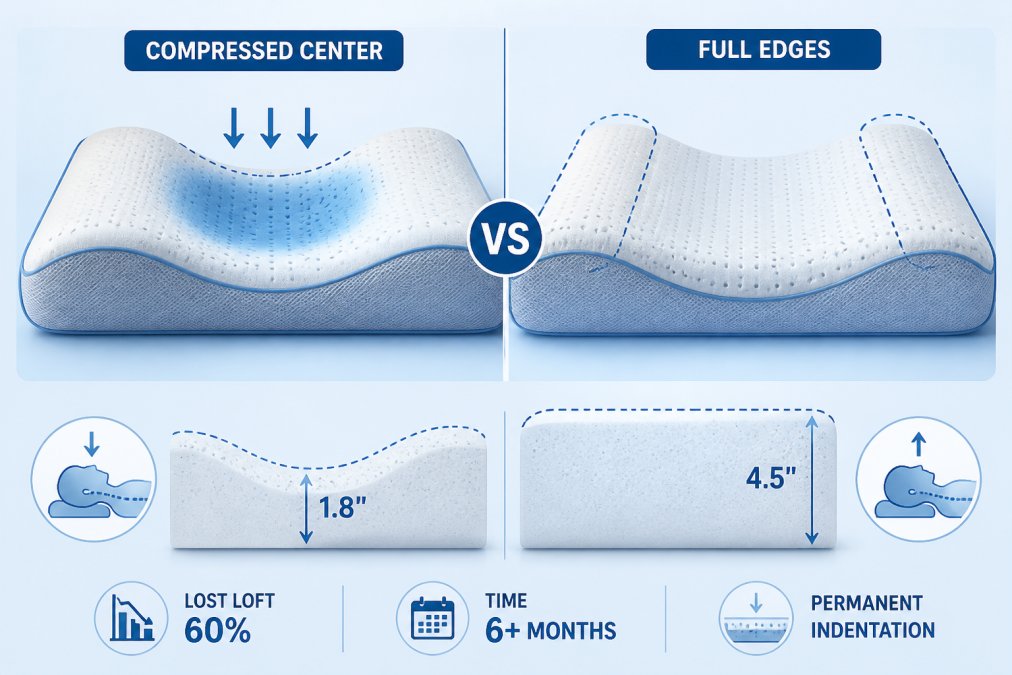
Memory foam loses firmness because the viscoelastic material has a limited number of compression cycles before permanent deformation occurs. Each night your head presses into the foam, but recovery is never 100 percent complete.
Cell Structure Breakdown and Compression Set
Memory foam is made of millions of interconnected cells that collapse when you lie on the pillow and re-expand when pressure is removed. Compression set, permanent deformation, occurs after thousands of cycles as the foam's cell structure loses elasticity, develops tiny fractures, and loses its rebound rate.
Lower-density foams flatten faster. A pillow with 4-pound density foam flattens more quickly than one with 5.3-pound density because higher density means more cell structure to compress before permanent deformation occurs.
How Body Heat and Thermal Sensitivity Affect Density
Memory foam is thermally sensitive, it softens when warm to conform better to your head, but this accelerates degradation. Repeated thermal cycling (heating, softening, compression, cooling, re-hardening) breaks down molecular bonds, reducing the foam's ability to hold its shape. You wake up with deeper indentations that don't fully recover, and loft visibly decreases.
Hot sleepers experience this faster than cold sleepers. If you sleep hot, your body generates more heat, which means more aggressive thermal cycling and faster degradation of the foam's structural integrity.
How Long Do Memory Foam Pillows Last Before Losing Support?
Most memory foam pillows lose noticeable support within 18 to 36 months of nightly use. Variance depends on foam density, body weight, sleep position, and usage frequency. Heavier sleepers and side sleepers (who concentrate pressure) flatten pillows faster. Rotating between multiple pillows extends lifespan by giving foam recovery time.
Budget pillows show visible flattening within 12 to 18 months; premium pillows maintain support for 3 to 4 years. Recognize when a pillow has lost enough firmness to no longer provide adequate cervical support, this varies by individual.
Shredded vs. Solid Memory Foam: Which Holds Firmness Longer?
Solid block memory foam compresses uniformly and cannot be restored once flattened. Shredded foam consists of small pieces that can be fluffed and redistributed to restore loft, extending lifespan through maintenance. However, shredded pieces degrade individually and eventually lose consistency. Both types eventually require replacement.
The Cervical Neck Pillow with Water Base features a built-in water chamber, allowing you to add or remove water for personalized support.

How to Stop Pillows from Going Flat and Maintain Firmness
You cannot stop memory foam from eventually flattening, but proper maintenance significantly slows the process.
The Physics of Slowing Compression Set
Fluffing re-expands compressed cells and delays noticeable compression set. Temperature control slows degradation, a pillow in a 65°F room degrades slower than one in a 75°F room. Alternating between two pillows reduces compression cycles by 50 percent per pillow, directly slowing compression set accumulation.
Proper Fluffing and Loft Management
Fluff every morning when foam is warm and pliable. For solid foam, shake vigorously and punch the center. For shredded foam, knead like bread dough. Rotate weekly (flip end-to-end and side-to-side) to distribute pressure evenly. Alternate between multiple pillows nightly to reduce compression cycles by 50 percent, one of the most effective maintenance strategies.
Temperature Control and Storage Best Practices
Keep your pillow in a cool bedroom (60°F-68°F) to slow thermal cycling. Store unused pillows in a cool, dry place away from sunlight and heat. Do not compress pillows for storage. Wash pillowcases weekly; spot-clean pillows only when necessary with mild soap and lukewarm water, then air-dry completely.
How to Test Whether Your Pillow Is Still Firm: The Fold Test and Compression Recovery Method
The Fold Test: Fold your pillow in half and release. A new pillow springs back in 2-5 seconds; moderate compression set takes 10-20 seconds; severe compression set takes 30+ seconds. Record monthly to track acceleration.
The Compression Recovery Method: Press your thumb into the pillow for 5 seconds. A new pillow shows no indentation; moderate compression set shows a shallow indentation (1/8 inch) fading in 2-3 minutes; severe compression set shows a deep indentation (1/4 inch+) persisting 5+ minutes.
The Loft Measurement: Measure height every 6 months. Loss of more than 1/2 inch per year indicates accelerated compression set; 1/4 inch or less per year is normal. If fold test recovery time increases despite maintenance, replacement is approaching.
Signs It Is Time to Replace Your Pillow
Signs your pillow needs replacement: morning neck pain or stiffness; visible permanent indentation that doesn't recover after fluffing; noticeably reduced loft; constant nighttime adjustments; or ownership beyond 3 years of nightly use.
Memory Foam Firmness and Sleep Position: Finding the Right Support
Back sleepers distribute weight evenly and need medium firmness; pillows flatten slowly. Side sleepers concentrate pressure on a smaller area and need firmer pillows to resist compression; they notice firmness loss faster. Stomach sleeping strains the neck regardless of pillow quality. Side sleepers depend on pillow resistance to maintain spinal alignment.
Cervinest's Pillow for Neck and Shoulder Pain is specifically contoured to maintain cervical support for both side and back sleepers. The design resists flattening in the critical neck support zone longer than standard memory foam pillows.
Recovery Time vs. Permanent Deformation: What Happens Inside the Foam
Understanding the difference between temporary compression and permanent deformation is essential to knowing when your pillow has truly failed versus when it simply needs fluffing.
How Temporary Compression Works
When you lie on a pillow, the foam compresses immediately. The viscoelastic cells collapse and conform to your head shape. This is temporary displacement, not damage. When you get up, the foam begins to recover. Within minutes to hours, the cells re-expand and the foam returns to near its original shape.
Recovery time is the duration required for the foam to return to 95 percent of its original loft after pressure is removed. For a new memory foam pillow, recovery time is typically 5 to 30 minutes, depending on foam density and ambient temperature. Higher-density foam recovers faster because the cell structure is more robust and elastic. Lower-density foam recovers more slowly because the cells are larger and less tightly packed.
Temperature dramatically affects recovery time. A pillow left in a 70°F room recovers faster than the same pillow left in an 85°F room. This is because heat softens the foam's polymer chains, making it harder for cells to re-expand against gravity and air resistance. A pillow left in a cool room (60°F) recovers noticeably faster than one in a warm room.
This is why your pillow feels firmer in the morning after a cool night than it does after a hot night. The foam has had more time to fully recover because the cooler temperature accelerated the recovery process.
How Permanent Deformation Accumulates
Permanent deformation, or compression set, occurs when the foam's cell structure is damaged and cannot fully recover. This is irreversible.
With each compression cycle, a tiny amount of permanent deformation occurs. The foam's cell walls develop microscopic fractures. The polymer chains that give the foam its elasticity break down slightly. After one night, the difference is imperceptible, the pillow recovers 99.5 percent of its original shape. After 100 nights, recovery might drop to 99 percent. After 1,000 nights (roughly 3 years), recovery might be only 95 percent.
This accumulation is not linear. Early in the pillow's life, compression set increases slowly. But as cell damage accumulates, the rate of degradation accelerates. A pillow that loses 5 percent of its firmness in the first year might lose 10 percent in the second year and 15 percent in the third year. This is why pillows often seem to fail suddenly, the degradation was gradual, but you only notice it once it crosses a threshold where it affects your sleep.
Compression set is permanent. Unlike temporary compression, which recovers fully, permanent deformation cannot be reversed. The damaged cells cannot repair themselves. The only solution is replacement.
Environmental Factors That Accelerate or Slow Recovery
Ambient Temperature is the single most influential factor. Foam at 60°F recovers roughly 20 to 30 percent faster than foam at 80°F. This is why pillows in air-conditioned bedrooms last longer than pillows in warm bedrooms. If you sleep in a room that is consistently above 75°F, you are accelerating compression set significantly.
Humidity affects recovery speed less dramatically than temperature, but it matters. High humidity (above 70 percent relative humidity) slightly slows foam recovery because moisture in the air reduces the rate at which the foam's polymer chains can move freely. Dry environments (below 40 percent humidity) allow slightly faster recovery. For practical purposes, humidity is a minor factor compared to temperature.
Foam Density determines the baseline recovery speed. A 5.3-pound-per-cubic-foot foam recovers faster than a 3.5-pound foam at the same temperature. Higher density means more material per cubic inch, which means stronger cell walls and faster elastic rebound. This is why premium pillows with higher-density foam maintain firmness longer, they recover more completely after each compression cycle, accumulating compression set more slowly.
Body Heat during sleep accelerates both recovery and degradation. While you sleep, your body warms the foam. This softens the foam and allows it to compress more deeply. When you wake up and the foam cools, it re-hardens. This thermal cycling creates stress on the cell structure. Hot sleepers experience faster compression set accumulation because their body heat creates more aggressive thermal cycling.
Diagnosing Your Pillow: Is It Temporary Compression or Permanent Deformation?
You can determine whether your pillow's loss of firmness is primarily temporary compression (normal and reversible) or permanent deformation (a sign of aging) by performing a simple diagnostic test.
The 24-Hour Recovery Test: In the morning, immediately after waking, measure your pillow's loft (height when lying flat). Record this measurement. Place the pillow in a cool room (60°F to 65°F if possible) without using it for 24 hours. Measure the loft again after 24 hours of rest.
If the pillow's loft increased by 1/4 inch or more, the loss of firmness you were experiencing was primarily temporary compression. The foam recovered fully with adequate rest and cool temperature. This is normal and does not indicate the pillow needs replacement.
If the pillow's loft increased by less than 1/8 inch, or did not increase at all, the loss of firmness is primarily permanent deformation. The foam cannot recover because the cell structure is damaged. This indicates compression set has progressed significantly, and replacement should be considered.
The Indentation Persistence Test: Press your thumb firmly into the pillow's surface for 5 seconds. Remove your thumb and observe the indentation.
If the indentation disappears within 30 seconds, the deformation is temporary. The foam is still elastic enough to recover quickly.
If the indentation persists for more than 2 minutes, or if it never fully disappears, the foam has permanent deformation. Compression set is advanced.
If the indentation disappears partially but not completely (a faint outline remains after 5 minutes), the pillow is in the intermediate stage, some compression set has occurred, but the foam still has some elasticity. This is typically when pillows are 2 to 3 years old and approaching the end of their useful lifespan.
Why Compression Set Accelerates Over Time
Compression set accelerates because damaged cells are weaker than undamaged cells. Once a cell's wall is fractured, it is more susceptible to further damage. The next compression cycle damages it more severely. This creates a cascade effect: early damage makes later damage more likely.
Additionally, as compression set accumulates, the foam becomes less able to distribute pressure evenly. Undamaged areas of the pillow support more weight than damaged areas. This concentrates stress on the remaining healthy cells, accelerating their degradation.
This is why the question "do memory foam pillows stay firm" has a finite answer: they stay firm until compression set reaches the point where the pillow no longer provides adequate support. For most people, that point arrives within 18 to 36 months of nightly use, depending on foam density, sleep position, body weight, and maintenance practices. Once permanent deformation becomes significant, no amount of fluffing or temperature control can restore the pillow's original firmness.
Choosing a Pillow That Maintains Firmness Longer
If you want a pillow that resists flattening longer than standard memory foam, focus on these specifications.
Foam density matters most. Look for pillows with foam density of 5 pounds per cubic foot or higher. This is higher than budget pillows but lower than ultra-premium options. The sweet spot for durability and comfort is typically 5 to 5.5 pounds per cubic foot.
Consider adjustable pillows. Water-based pillows and pillows with removable inserts let you modify support as the foam gradually softens. This extends the pillow's useful lifespan because you can compensate for firmness loss.
Read reviews specifically about long-term durability. Marketing claims about "cooling" or "conforming" do not tell you about compression set. Real user reviews mentioning flattening after 6 months or 3 years are more informative.
The Orthopedic Pillow for Neck Pain at $44.99 offers ergonomic cervical alignment and relieves neck pain. The Cervical Neck Pillow with Water Base at $59.99 adds water-level customization for personalized support. For deep, peaceful sleep, consider the Orthopedic Neck Support Pillow at $104.99.


Conclusion
Memory foam pillows do not stay firm permanently. The viscoelastic material undergoes compression set, permanent deformation, with each compression cycle. Most pillows lose noticeable firmness within 18 to 36 months, depending on foam density, your body weight, sleep position, and maintenance practices. Shredded foam pillows can be fluffed to restore some loft, extending their useful lifespan. Solid foam pillows flatten gradually and irreversibly.
You cannot stop this process, but you can slow it significantly with proper fluffing, rotation, temperature control, and using multiple pillows to distribute wear. When your pillow no longer provides adequate cervical support, indicated by morning neck pain, visible indentation, or noticeably reduced loft, replacement is necessary.
If you are tired of buying pillows that flatten within months, Cervinest's cervical pillows are designed to provide essential support for your neck and head during sleep. The water-adjustable design of the Cervical Neck Pillow with Water Base lets you personalize your support. Experience the difference a high-quality cervical pillow can make.
Frequently Asked Questions
Why do memory foam pillows lose their shape over time?
Memory foam loses firmness because repeated compression causes permanent deformation of the foam's cell structure. When you rest your head on the pillow night after night, the viscoelastic cells don't fully recover to their original state. Over months of use, this compression set accumulates, reducing the pillow's ability to provide the same level of support. Environmental factors like body heat, humidity, and room temperature also accelerate this process by softening the foam's structural integrity.
How long do memory foam pillows last before they go flat?
Most quality memory foam pillows maintain adequate firmness for 18 to 36 months with regular use. Budget options may flatten within 6 to 12 months, while premium pillows with higher density foam can last 3 to 5 years. The lifespan depends on foam density, your sleep position, body weight, and how well you maintain the pillow. Side sleepers typically experience faster compression than back sleepers because of concentrated pressure on one area.
What's the difference between shredded and solid memory foam for staying firm?
Solid block memory foam maintains consistent firmness longer because its cell structure remains intact as a single unit. Shredded memory foam, made of small pieces, compresses more quickly because individual shreds shift and settle over time, creating gaps that reduce overall loft and support. However, shredded foam offers better adjustability and breathability, making it a trade-off between firmness retention and comfort customization. Your choice depends on whether you prioritize long-term firmness or immediate pressure relief.
How can I tell if my memory foam pillow is worn out and needs replacing?
Your pillow is worn out when it no longer fills the gap between your neck and mattress, no longer rebounds within a few seconds after you lift your head, feels noticeably thinner than when new, causes morning neck stiffness despite previously providing relief, or shows visible permanent indentations that don't recover. If you're waking with neck pain after years of comfort, that's a clear sign the foam has lost its supportive properties and compression set has become permanent.