
Best Pillows for Chronic Neck Stiffness
Table of Contents
- Best Pillows for Chronic Neck Stiffness: Quick Comparison
- How Sleeping Position Affects Neck Stiffness
- Best Pillow for Side Sleepers with Neck Pain
- Understanding Pillow Loft and Firmness for Neck Support
- Pillow Height for Neck Pain: Finding Your Ideal Fit
- Cervical Pillow for Neck Pain: Materials and Design
- How to Sleep with Neck Pain: Positioning and Adjustment Tips
- Durability and Maintenance for Long-Lasting Neck Support
- Signs Your Pillow Is Causing Neck Pain
- Frequently Asked Questions
Last Updated: October 7, 2026
Best Pillows for Chronic Neck Stiffness: Quick Comparison
Chronic neck stiffness affects millions who spend their days hunched over screens or sleeping in poor positions. Finding the right pillow is one of the most direct ways to address it. The best pillows for chronic neck stiffness share three qualities: proper cervical support, appropriate loft for your body type, and materials that hold their shape through the night.
A pillow that works maintains neutral spine alignment, your cervical spine in its natural curve, not twisted or compressed. When it fails, your neck muscles work overtime to compensate, and you wake up stiff and sore.
Below are the key factors that separate effective neck support from wasted money, plus recommendations for different sleep positions and body types.
| Pillow Type | Best For | Starting Price | Key Benefit |
|---|---|---|---|
| Orthopedic Pillow for Neck Pain | General neck pain relief | $48.00 | Universal support for side and back sleepers |
| Cervical Neck Pillow with Water Base | Customizable firmness | $59.99 | Adjustable support to match your exact needs |
| Pillow for Neck and Shoulder Pain | Shoulder tension | $94.99 | Contoured design for neck and shoulder relief |
| Orthopedic Neck Support Pillow | Tech neck and chronic stiffness | $106.00 | Premium support for severe tension |
How Sleeping Position Affects Neck Stiffness
Your sleeping position determines how much support your neck needs. Side, back, and combination sleepers each require different pillow geometries to maintain neutral spine alignment.

Side sleepers face a specific challenge: the gap between shoulder and neck must be filled precisely. Too low and your neck bends downward; too high and it bends upward. The ideal pillow has enough loft to bridge that gap while keeping your head level with your spine. Many people with chronic neck stiffness are side sleepers using pillows that collapse within weeks, forcing misalignment night after night.
Back sleepers need less loft but consistent support under the cervical curve. Your neck has a natural inward curve, called cervical lordosis, and a good pillow cradles it rather than flattening it. A pillow that's too thick or firm pushes your head into a chin-down position, creating tension in the upper trapezius muscles.
Combination sleepers have it hardest: you need a pillow that performs in multiple positions without constant adjustment. Choose medium firmness and moderate loft that doesn't overcorrect in any position.
Best Pillow for Side Sleepers with Neck Pain
Side sleeping is the most common position and where pillow choice matters most for chronic neck stiffness. The Pillow for Neck and Shoulder Pain has a contoured cervical shape that fills the gap between shoulder and neck, something generic pillows cannot do.
Its contoured design supports your neck on your side or back, which matters because most side sleepers shift positions during the night. Consistent support means you're not waking with the sharp pain of your neck bending into a stress position at 3 a.m.
For side sleepers with broad shoulders, this is even more critical. A standard pillow won't fill the larger gap your body creates, leaving your neck unsupported. Our contoured side sleeper option addresses this directly.
Durability is the real test. Many side sleepers report pillows going flat within weeks as material compresses under head and shoulder weight. This pillow maintains its structure, so the support you get on night one is the support you get on night 200.
Understanding Pillow Loft and Firmness for Neck Support
Pillow loft is the height of the pillow lying flat, measured in inches from base to top, a measurable specification that directly affects spinal alignment.
For side sleepers, the ideal loft typically ranges from 4 to 6 inches, depending on shoulder width. Broader shoulders require higher loft to fill the gap. For back sleepers, 3 to 4 inches usually works better because your shoulder doesn't create a gap the same way.
Firmness is different from loft: a pillow can be tall and soft, or short and firm. For chronic neck stiffness, firmness matters because soft pillows compress too quickly, your head sinks in, and by morning the support has flattened. You need enough firmness to resist compression while still feeling comfortable.
The mistake most people make is choosing on feel alone. A pillow feels great in the store after 30 seconds, but after eight hours a too-soft pillow has compressed significantly, changing the support profile entirely. Firmness that resists compression over months prevents the "my pillow goes flat" cycle.
Pillow Height for Neck Pain: Finding Your Ideal Fit
Most guides tell you the "right" loft without acknowledging that your ideal height depends on your body dimensions, your mattress, and how much you move at night. The result is a pillow that works for someone else's body, not yours.
Measure Your Shoulder-to-Neck Gap First
Measure the gap between your shoulder and neck while lying on your side, that gap is roughly the loft you need. For most adults this falls between 4 and 6 inches. A person with 16-inch shoulder width typically needs lower loft than someone with 20-inch shoulders, because the wider shoulder creates a larger gap to fill.
Mattress firmness changes the calculation. On a softer mattress your shoulder sinks deeper, reducing the gap and requiring less loft; on a firmer mattress your shoulder stays higher, requiring more. People who switch from soft to firm often find their old pillow suddenly feels too low, the pillow didn't change, but the geometry did.
The Back-Sleeping Test
For back sleeping, your cervical curve needs support, but too much height pushes your chin down. Test it: lying on your back, you should fit one finger horizontally under your neck. More than one means the pillow is too low; none means it's too high. This directly measures whether the pillow fills the cervical lordosis without overcorrecting it.
How to Adjust a Pillow You Already Own
Many pillows can be customized after purchase. With a shredded memory foam pillow, remove fill through the zipper to lower the loft, start with about 10 percent, sleep on it two nights, then adjust. Removing too much at once makes it hard to tell whether the change helped.
With a solid foam pillow, add a folded towel under the pillowcase to raise height by a half-inch at a time, a temporary fix useful for testing what loft works before buying new.
Water-based pillows adjust even more directly. The Cervical Neck Pillow with Water Base lets you add or remove water to change height and firmness: adding water raises loft and firmness, removing lowers and softens. "One size fits all" pillows are a compromise that works adequately for most but optimally for almost no one. Adjustable fill lets you dial in the exact height and firmness your neck needs, and re-adjust if your body changes, weight gain, weight loss, or a new mattress all shift the ideal loft.
Why This Matters for Chronic Stiffness
If your pillow is too low, your neck bends downward and your muscles work to hold your head up; too high, and your neck bends upward and your muscles pull your head back into alignment. Either way, you wake up stiff. The difference between a pillow that works and one that doesn't is often a half-inch of loft, which is why adjustment matters more than brand.
Cervical Pillow for Neck Pain: Materials and Design
The material inside your pillow determines how well it maintains support over time, and for people with chronic neck stiffness, how well you sleep. Two factors matter most: compression response and heat management.
Material Trade-Offs: What Each Fill Actually Does
Shredded memory foam is the most common orthopedic fill because it conforms to your head while resisting compression better than solid foam. Shredding allows air circulation, preventing heat buildup and extending lifespan. The trade-off: it can shift inside the pillow, so you may need to redistribute it occasionally.
Solid memory foam holds its shape more consistently than shredded foam but traps heat. If you sleep hot, it can make you wake up sweaty, disrupting sleep and worsening pain perception the next day. Many solid foam pillows now include gel infusions or graphite particles to pull heat away, but the effect varies and is often overstated.
Latex is more responsive than memory foam, bouncing back faster when you move, which reduces the "stuck in one spot" feeling for frequent position shifters. It's naturally hypoallergenic, dust-mite resistant, and sleeps cooler than memory foam because it's more breathable. The trade-off: it feels firmer and less contouring, so some people with chronic stiffness find it less comfortable the first week.
Water-based systems like Cervinest's Cervical Neck Pillow with Water Base offer dynamic support. Water adjusts to your movement through the night, cradling your head without the "locked in" feeling of solid foam. This reduces pressure points, areas where your head bears too much weight on one spot. Water's high heat capacity also draws heat away from your head, regulating temperature through the night.
Why Thermal Regulation Matters for Chronic Pain
Chronic pain sufferers often experience sleep disruption from temperature. When you overheat, you wake, shift positions, and disrupt the alignment your neck has settled into, each disruption a chance to move into a stress position. A pillow that sleeps hot actively undermines the support it's supposed to provide.
If you sleep hot, prioritize breathable materials: latex, shredded foam with open-cell structure, or water-based systems. If you sleep cold, memory foam's heat retention is an advantage. Match the material to your body, not the marketing copy.
Design: Contouring and the Break-In Period
Design matters as much as material. A contoured cervical design has a depression for your head and a raised edge that supports your neck's natural curve, actively maintaining alignment rather than passively supporting whatever position you're in.
But most guides don't tell you: switching to a contoured pillow often feels worse before it feels better. Your neck muscles have adapted to poor alignment, and proper alignment feels unfamiliar. Expect 3 to 7 days of mild discomfort as muscles adjust, normal and typically quick to resolve.
Don't abandon the new pillow after one uncomfortable night, most people need a full week to adjust. If pain intensifies rather than improves after a week, the pillow may not fit your body type. To ease the transition, use the new pillow for the first half of the night and your old one for the second, gradually increasing time on the new pillow.
How to Sleep with Neck Pain: Positioning and Adjustment Tips
The best pillow won't fix poor sleep positioning. Actively practice neutral spine alignment, especially while adjusting to a new pillow.

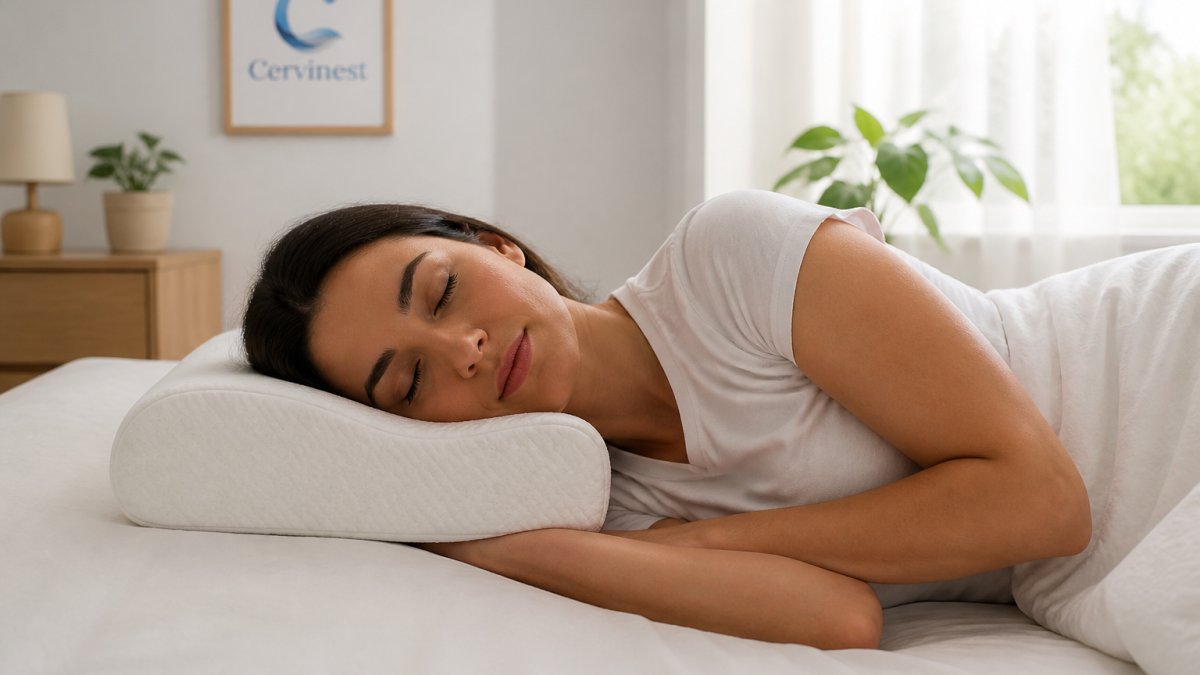
For side sleeping: Keep your head level with your spine, a straight line from ear through shoulder to hip. Place a pillow between your knees to prevent spinal twisting. Your bottom arm can be extended or tucked; what matters is that your top shoulder doesn't roll forward.
For back sleeping: Place a pillow under your knees to reduce lower-back stress. Your chin should rest neutral, not tilted up or down. Tilting your head back means the pillow is too low; chin tucking down means it's too high.
Transition protocol: Switching from a flat pillow to an orthopedic one brings a 3-to-7-day adjustment period. Your neck muscles have adapted to poor alignment, and proper alignment feels unfamiliar at first. Mild discomfort as muscles adjust is normal and typically resolves quickly.
Don't abandon the new pillow after one uncomfortable night. Most people need a full week to adjust. If pain intensifies rather than improves after a week, the pillow may not be the right fit for your body type.
Durability and Maintenance for Long-Lasting Neck Support
A pillow that goes flat stops working. Durability is essential for managing chronic neck stiffness because inconsistent support creates inconsistent pain.
Memory foam density is the key spec. Higher density resists compression longer: 5 lb/cubic foot lasts significantly longer than 3 lb/cubic foot, though it feels firmer initially.
Maintenance extends lifespan. Wash your pillowcase weekly and the pillow cover every two weeks, most orthopedic pillows have removable, washable covers. Air out your pillow in sunlight monthly to prevent moisture and odor buildup that degrades the fill.
Never machine wash the pillow itself unless the manufacturer says it's safe. Most orthopedic pillows should be spot-cleaned or hand-washed gently. The Orthopedic Pillow for Neck Pain arrives 100% odor-free and stays fresh when cared for properly.

A quality orthopedic pillow lasts 2 to 3 years before the fill compresses noticeably, far longer than standard pillows, which often flatten within 6 to 12 months. The longer lifespan makes the higher upfront cost better value over time.
Signs Your Pillow Is Causing Neck Pain
Sometimes your pillow is actively making chronic neck stiffness worse. Recognizing these signs lets you fix the problem before months of poor sleep compound your pain.
Morning stiffness that worsens over time: If manageable neck pain has gotten worse over the past month, your pillow is likely compressing. As it flattens, your neck gets progressively less support each night.
Waking with your head in an odd position: Consistently waking with your head tilted or rotated means your pillow isn't stable enough, you're unconsciously adjusting all night because it doesn't support any single position adequately.
Shoulder pain alongside neck pain: This often signals the wrong loft for your sleeping position, either the gap isn't filled (too low) or your shoulder is pushed up unnaturally (too high).
Constant need to adjust or fluff: Fluffing multiple times per night means the pillow isn't holding its shape. You need better compression resistance.
Headaches upon waking: Tension headaches often originate from neck misalignment. If headaches appeared after switching pillows or worsened gradually, the pillow is likely the culprit.
When you notice these signs, don't accept them, switch to a pillow designed for proper cervical support. The Orthopedic Neck Support Pillow is engineered to combat tech neck tension and chronic stiffness, with materials and design that maintain support all night.
Chronic neck stiffness is rarely solved by one intervention, but the foundation is sleep. Eight hours of poor spinal alignment undoes good daytime posture, physical therapy, and ergonomic improvements. Cervinest's orthopedic pillows maintain neutral spine alignment all night, so you wake without the morning pain that compounds stiffness. Start with the Orthopedic Pillow for Neck Pain if you're new to cervical support, or the Orthopedic Neck Support Pillow for severe chronic tension. Both cradle your head, fill the gap between neck and mattress, and help you find relief through better sleep.
Frequently Asked Questions
What is the best pillow for chronic neck pain?
The best pillow for chronic neck pain combines proper cervical support with personalized adjustability. Look for pillows with contoured designs that fill the gap between your neck and mattress, maintaining neutral spine alignment. The Orthopedic Neck Support Pillow ($106) is specifically designed to melt neck tension and combat tech neck, while the Cervical Neck Pillow with Water Base ($59.99) lets you customize support by adjusting water levels to match your body type and sleep position.
What pillow height is best for neck pain?
Pillow height should keep your head and neck aligned with your spine, not tilted up or down. The Pillow for Neck and Shoulder Pain ($94.99) features a contoured cervical design that adapts to both side and back sleepers, eliminating the need to constantly adjust or fluff your pillow throughout the night.
Are cervical pillows good for chronic neck stiffness?
Yes, cervical pillows are specifically designed to address chronic stiffness by supporting the natural curvature of your neck and maintaining spinal alignment during sleep. The Cervical Neck Pillow with Water Base uses gentle water pressure to cradle your head and guide your body into proper alignment, preventing morning stiffness. Orthopedic cervical designs reduce pressure points and allow neck muscles to relax fully, leading to deeper, more restorative sleep.
How do I know if a pillow will last, or if it will flatten like my previous pillows?
Look for pillows with durable construction and consistent support throughout the night. Quality orthopedic pillows maintain their shape and firmness level over months of use. The Orthopedic Pillow for Neck Pain ($48) arrives odor-free and ready for immediate use, providing reliable cervical alignment without degradation. Pillows with adjustable fill (like water-based options) allow you to maintain consistent support by adding or removing material as needed, extending the pillow's functional life.