
Best Cervical Pillow for Broad Shoulders
Table of Contents
- Why Broad Shoulders Need a Different Cervical Pillow
- Understanding Pillow Loft for Broad Shoulders
- Best Pillow for Side Sleepers with Broad Shoulders
- Cervical Pillow for Side Sleepers: Maintaining Neutral Alignment
- Pillow for Neck and Shoulder Pain Relief
- Firmness, Support, and Material Choices
- Cervinest Cervical Pillow Options: Comparison and Selection
- How to Choose: Key Questions Before You Buy
- Frequently Asked Questions
Last Updated: October 15, 2026
Why Broad Shoulders Need a Different Cervical Pillow
A cervical pillow for broad shoulders solves a problem that standard pillows ignore: the gap. When you have broad shoulders, your neck doesn't sit at the same height as someone with narrower shoulders.

Most pillows are designed for average body types. They work fine for some people but leave broad-shouldered sleepers with either a pillow that's too low (causing your neck to bend down) or too high (causing it to bend up).
Side sleepers with broad shoulders often report waking with stiffness, shoulder tension, and headaches, not because they're sleeping wrong, but because their pillow wasn't built for their body type. The solution isn't to accept discomfort.
Below, we'll show you exactly how to measure your needs, understand pillow loft, and find the cervical pillow that actually works for your shoulders.
Understanding Pillow Loft for Broad Shoulders
Pillow loft is the height of the pillow when you're lying on it, not the height on the shelf. For broad shoulders, loft matters more than it does for other body types because your shoulders sit higher off the mattress, and that extra height has to be filled or your neck bends to compensate.
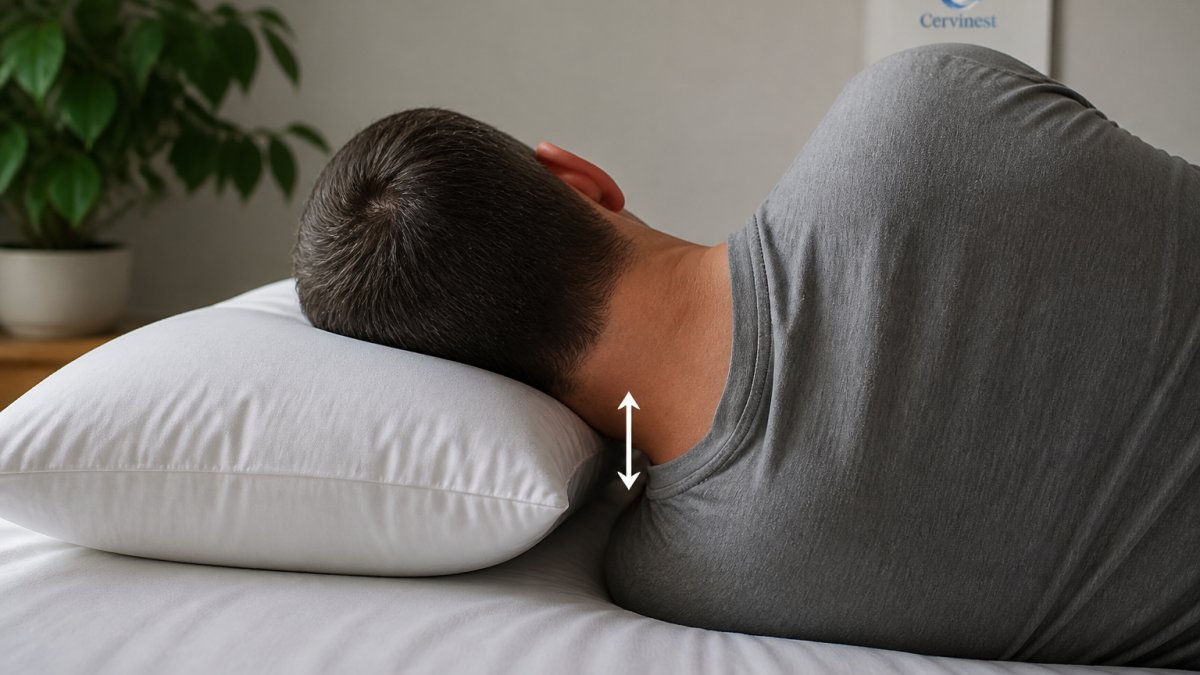
Think of it this way: your neck needs support that fills the space between your shoulder and your head. If your shoulders are broad, that space is larger. A standard loft pillow leaves air between your neck and the pillow, forcing your neck to angle downward. That's misalignment.
The right loft depends on four things, not three: your shoulder width, your mattress firmness, your sleeping position, and how much your body sinks into the mattress overnight. Most guides stop at the first three. The fourth is where people get burned.
A Repeatable Way to Measure Your Shoulder-to-Mattress Gap
Most advice says "buy a high-loft pillow" and stops there. That's not actionable. Here's a method you can run in about ten minutes with a tape measure, a wall, and your own bed.
Step 1: Measure your shoulder width. Stand with your back against a wall, heels and shoulder blades touching.
Step 2: Measure your shoulder-to-ear distance on your side. Lie on your bed in your normal side-sleeping position, on the side you actually sleep on.
Step 3: Convert the gap to a loft target. Add roughly 1 to 2 inches to your measured gap to account for the pillow compressing under your head weight. That sum is your target loft.
Step 4: Re-measure on the mattress you actually sleep on. This is the step almost everyone skips.
How Mattress Firmness Changes the Required Loft
Your mattress changes the math more than most people realize. A firm mattress keeps your shoulder closer to the surface, so the gap is smaller and you need less loft. A soft or pillow-top mattress lets your shoulder sink in, which widens the gap and pushes your loft requirement up.
A rough way to think about it: moving from a firm mattress to a soft one can add roughly half an inch to an inch to the loft you need, depending on your body weight and how much the mattress compresses under you.
This is why the same pillow can feel perfect for a month and then start causing stiffness. If you changed mattresses, added a topper, or your mattress softened with age, your required loft changed too, even though your shoulders didn't.
Quick Reference: Gap Size to Loft Range
| Measured gap (mattress to ear) | Target loft (with compression allowance) | Typical fit |
|---|---|---|
| Under 3 inches | 3 to 4 inches | Narrow shoulders, firm mattress, or back sleeping |
| 3 to 4 inches | 4 to 5 inches | Average-to-broad shoulders on a medium mattress |
| 4 to 5 inches | 5 to 6 inches | Broad shoulders, softer mattress, or heavier sleeper |
| Over 5 inches | 6 inches or adjustable | Very broad shoulders, very soft mattress, or both |
These ranges are starting points, not prescriptions. The only test that matters is whether your ear, shoulder, and hip line up when you're lying down, which we cover in the alignment section below.
Why Finger-Width Estimates Fall Short
The common "how many fingers fit in the gap" trick is a decent sanity check, but it's not a measurement. Finger width varies from person to person, and it doesn't account for mattress compression at all. Use it as a gut check after you've done the tape-measure method, not as a substitute for it.
Many people with broad shoulders underestimate how much loft they need because they've adapted to pillows that are too low. If you've been sleeping on the same pillow for years and just tolerating morning stiffness, re-measure before you assume your current pillow is right.
Best Pillow for Side Sleepers with Broad Shoulders
Side sleeping is the most common position for people with broad shoulders because it naturally aligns the spine when the pillow height is right. But "right" is the challenge.
For side sleepers with broad shoulders, the pillow must do two things: fill the gap between your shoulder and head, and keep your cervical spine straight, not angled up or down. A pillow that's too low forces your neck down.
The best pillows for this group have adjustable or high-profile support. Memory foam options work well because they contour to your neck and shoulder, distributing pressure evenly.
Cervinest's cervical pillow for broad shoulders is designed with this exact scenario in mind. The contoured shape supports both your neck and shoulder, filling that critical gap while maintaining neutral alignment.
Cervical Pillow for Side Sleepers: Maintaining Neutral Alignment
Neutral alignment means your cervical spine forms a straight line from your head through your neck to your shoulders. When you're lying on your side, your pillow should keep that line straight, not curved up, not curved down.
To check your alignment, lie on your side and have someone take a photo from the side. Your ear, shoulder, and hip should form a roughly straight line. Your neck should not be bent forward or backward. If your pillow is too low, your neck bends down and that line breaks.
A cervical pillow for side sleepers with broad shoulders maintains this alignment by supporting both the head and the upper neck, while also filling the shoulder gap. This prevents the common problem where your head is supported but your neck is left unsupported, creating a kink.
Testing Neutral Alignment and Identifying Misfit
The best test happens over a few nights, not in a store. Pay attention to where you feel tension.
Neck tension at the base of your skull usually means the pillow is too high. Your head is being pushed up, straining the muscles where your neck meets your skull. Shoulder tension or stiffness in your upper back usually means the pillow is too low.
If you wake up with a headache, the pillow is likely too high. If you wake up with your neck stiff and sore, it's too low. If you're constantly adjusting the pillow during the night, it's either the wrong height or the wrong firmness.
A pillow that fits right feels invisible. You don't think about it. You fall asleep and wake up without tension.
Pillow for Neck and Shoulder Pain Relief
Neck and shoulder pain often comes from poor pillow support, but it can also come from years of poor posture, tension, or underlying issues.
For people with chronic neck or shoulder pain, the pillow needs to do more than just support, it needs to relieve pressure. A contoured cervical pillow reduces pressure points by distributing your head and neck weight evenly instead of concentrating it in one spot.
Memory foam is effective for pain relief because it molds to your exact shape, eliminating pressure points. Orthopedic pillows with firm support help if your pain comes from instability or lack of support.
The right pillow can make a measurable difference. The pain doesn't disappear, but the morning stiffness lessens, and they stop waking up already tense.
Firmness, Support, and Material Choices
Three materials dominate the cervical pillow market: memory foam, latex, and water. Each behaves differently under a broad-shouldered sleeper's weight, and each has a different lifespan before it stops doing its job. Most guides cover feel and skip the part that actually costs you money: how long the pillow holds its loft, and what you have to do to keep it there.
Memory Foam
Memory foam is the most popular fill. It's responsive, comfortable, and molds to your shape. For broad-shouldered sleepers, memory foam works well if the pillow has enough loft and firmness to support your weight without collapsing.
The trade-offs are real. Memory foam softens over time as the cell structure breaks down, and it can retain heat.
Durability and loft retention: Expect noticeable softening in 2 to 3 years with nightly use. Higher-density foams hold up longer than low-density ones, but density isn't always printed on the label.
Care: Most memory foam cores can't be washed. Spot-clean the core, wash the cover per the tag, and keep the pillow out of direct sun. A washable, removable cover is the single biggest factor in how long the pillow stays hygienic.
Latex
Latex is naturally cooling and durable. It doesn't soften as quickly as memory foam. Latex pillows tend to be firmer and less contouring, which can be good if you want stable support or bad if you prefer a softer feel. For neck pain, latex's firmness and support are often a good match.
Durability and loft retention: Latex is the longest-lasting of the three. Five or more years is common, and it tends to hold its original height better than foam. If you want a pillow you won't have to replace every couple of years, latex is the low-maintenance pick.
Care: Latex cores generally shouldn't be machine-washed. Air them out, spot-clean as needed, and wash the cover. Latex is naturally resistant to dust mites and mold, which is a genuine advantage for allergy-prone sleepers.
Water Base
Water-based pillows are adjustable. You control how much water is inside, which changes both the firmness and the loft. This is valuable for broad-shouldered sleepers because you can fine-tune the height to match your exact gap. Water also stays cool, which helps with temperature regulation.
Durability and loft retention: The water chamber itself typically lasts 3 to 5 years. The failure point is usually the seal or the bladder, not the fill. Loft retention is excellent as long as the chamber holds, because water doesn't compress the way foam does.
Care: Drain and refill periodically per the manufacturer's instructions, and check the seal for leaks. Don't overfill, since that makes the pillow firmer than intended and can stress the chamber. The cover is usually machine-washable.
Firmness: What Broad Shoulders Actually Need
Firmness matters. A pillow that's too soft won't support your neck and will collapse under your head weight. A pillow that's too firm can feel uncomfortable and create pressure points. For broad shoulders, a medium to medium-firm pillow usually works best, firm enough to support your weight without collapsing, soft enough to be comfortable.
The reason firmness matters more for broad shoulders than for narrow ones is leverage. The wider the gap between your shoulder and your head, the more downward force your head puts on the pillow, and the more a soft pillow collapses. A pillow that feels pleasantly soft to an average sleeper can flatten completely under a broad-shouldered side sleeper.
Material Comparison
| Material | Best For | Typical lifespan | Temperature | Adjustability |
|---|---|---|---|---|
| Memory Foam | Comfort and contouring | 2 to 3 years | Can retain heat | Fixed loft |
| Latex | Cooling and support | 5+ years | Naturally cool | Fixed loft |
| Water Base | Customization and support | 3 to 5 years | Stays cool | Adjustable loft |
Care, Durability, and Long-Term Loft Retention
This is the part most buying guides skip, and it's the part that determines whether your pillow still works in year two.
- Rotate or flip your pillow if the design allows it. Even foam pillows benefit from being flipped periodically to distribute compression.
- Use a pillow protector under the pillowcase. It keeps sweat, oils, and dust out of the core, which is the main reason pillows get replaced before they wear out.
- Wash covers, not cores. Most cores can't survive a washing machine. Check the tag before you do anything.
- Re-measure your gap yearly. Foam softens, mattresses soften, and bodies change. A pillow that fit two years ago may not fit now.
- Watch for the tell-tale signs of loft loss: waking up with neck stiffness you didn't have before, needing to fold or stack the pillow, or the pillow feeling noticeably flatter than when you bought it.
Cervinest Cervical Pillow Options: Comparison and Selection
Cervinest offers four cervical pillow options, each designed for different needs and preferences.
Cervical Neck Pillow with Water Base
The Cervical Neck Pillow with Water Base ($61.00) is our most customizable option. The built-in water chamber lets you add or remove water to adjust both loft and firmness to match your exact shoulder width and mattress.
This is the pillow for people who've tried multiple options and never found the right fit. Because you control the water level, you can dial in the perfect height for your body. The water pressure gently cradles your head and neck, maintaining natural curvature without pressure points.
For broad-shouldered side sleepers, this pillow solves the gap-filling problem because you can make it as high as you need. It's also ideal if your mattress is softer than average or if you want to adjust the pillow as your needs change.
Orthopedic Pillow for Neck Pain
The Orthopedic Pillow for Neck Pain ($48.00) is our most affordable option and works well for side sleepers who want solid support without customization.

This pillow restores natural neck posture with an ergonomic cervical design. It's firm enough to support your head and neck without collapsing, but contoured enough to be comfortable. It eliminates morning soreness and stiffness by keeping your cervical spine aligned throughout the night.
For broad shoulders on a budget, this is a strong starting point. It won't let you customize the loft, but it's designed with standard broad-shoulder dimensions in mind.
Orthopedic Neck Support Pillow
The Orthopedic Neck Support Pillow ($106.93) is our premium option for people with chronic pain or those who want maximum support and cooling.

This pillow cradles your head with a firm orthopedic design and includes a wedge extension that keeps your head and neck perfectly level in any position. It's engineered to relieve headaches and neck pain by providing optimal back and side support. Integrated airflow channels prevent overheating, so you sleep cooler and don't toss and turn as much.
For broad-shouldered sleepers with chronic neck or shoulder pain, this pillow's firmness and support can help alleviate discomfort. The non-toxic, non-allergenic foam arrives fresh with zero chemical smell, and the machine-washable cover makes maintenance easy.
Pillow for Neck and Shoulder Pain
The Pillow for Neck and Shoulder Pain ($95.00) is designed specifically for people whose pain extends beyond the neck into the shoulders.
This pillow supports your neck while reducing tension from the day. Its contoured cervical design works for both side and back sleepers, keeping your head and neck comfortably aligned. The consistent support throughout the night reduces the need to constantly adjust or fluff the pillow, you stay in alignment instead of chasing comfort.
For broad-shouldered side sleepers with shoulder tension, this pillow's contoured shape fills the gap and supports the shoulder area, not just the neck.
How to Choose: Key Questions Before You Buy
Ask yourself these questions to narrow down the right pillow:
Do you want to customize the loft, or do you prefer a fixed height? If you've struggled to find the right height, the water-based pillow lets you dial it in. If you want simplicity, choose a fixed-loft option.
Is your primary concern neck pain, shoulder pain, or general support? If it's neck pain, the Orthopedic Pillow for Neck Pain or the Orthopedic Neck Support Pillow work well.
What's your budget? The Orthopedic Pillow for Neck Pain is the most affordable. The water-based pillow is mid-range and offers customization.
How firm do you like your pillow? Memory foam contours and is softer. Water-based pillows are firmer and more stable. Orthopedic pillows are firmest. For broad shoulders, firmness is actually an advantage because it prevents collapse under your weight.
Do you sleep hot? Water and latex stay cooler than memory foam. If temperature is a factor, choose the water-based pillow or the Orthopedic Neck Support Pillow with airflow channels.
Frequently Asked Questions
How high should a pillow be for a side sleeper with broad shoulders?
Pillow height depends on your shoulder width and mattress firmness. Broad shoulders typically need a higher loft (4-6 inches) to fill the gap between your neck and the mattress while maintaining neutral cervical spine alignment. A firmer mattress requires a slightly lower loft; a softer mattress may require a higher one. The best test: lie on your side and check that your head, neck, and spine form a straight line, not tilted up or sagging down.
What is the best cervical pillow for side sleepers with broad shoulders?
The best cervical pillow for broad-shouldered side sleepers has contoured support, adequate loft, and consistent firmness. Look for pillows with a cervical curve that cradles your neck and a wider base that supports your shoulder area. Contoured designs help fill the shoulder-to-head gap more effectively than flat pillows. Memory foam and orthopedic materials offer better shape retention than traditional pillows, preventing the collapse that leaves you unsupported after a few months of use.
Can a cervical pillow help with neck and shoulder pain from desk work?
Yes. Cervical pillows designed for neck and shoulder pain relief work by maintaining proper spinal alignment during sleep, allowing neck muscles to relax and recover from daytime tension. A properly fitted cervical pillow reduces the strain on your cervical spine and shoulders, easing morning stiffness and reducing headaches. However, a pillow alone cannot fix poor daytime posture, it complements ergonomic desk setup and stretching, but doesn't replace them.
How do I know if my cervical pillow is too high or too low?
If your pillow is too high, your head tilts upward, creating neck strain and potentially causing headaches. If it's too low, your head sags, leaving your cervical spine unsupported. To test: lie on your side and use a mirror or ask someone to check if your head, neck, and spine form a straight horizontal line. Your ear should align with your shoulder. Adjust the pillow's loft or firmness until you achieve this neutral position.
Why do my pillows go flat within a few months?
Standard pillows lose loft over time as the filling compresses under nightly pressure. Pillows with poor-quality materials or thin filling compress faster. Orthopedic and memory foam pillows retain their shape longer because they're denser and designed to resist compression. Water-based pillows maintain consistent support because water doesn't compress, it adjusts dynamically. If durability is a concern, choose pillows with high-density foam or adjustable fill systems that let you add support as needed.
Broad shoulders and side sleeping create a unique set of needs that standard pillows don't address. The gap between your shoulder and your mattress is real, and filling it properly changes sleep quality and reduces pain. Cervinest's cervical pillows are built specifically for this challenge. Whether you need adjustable support, pain relief, or firm orthopedic alignment, we have a pillow designed for your body type. Get started with Cervinest and wake up without neck tension.