
Stretches to Relieve Neck Tension Before Bed
Table of Contents
- Why Neck Tension Builds Up During the Day (and Why Bedtime Is the Best Time to Release It)
- What You'll Need: Setup and Safety Before You Start
- A 10-Minute Timed Routine: Stretches to Relieve Neck Tension Before Bed
- Gentle Neck Stretches in Bed You Can Do Lying Down
- How to Relax Shoulders and Neck in Bed With Breathing Cues
- Lying Down Neck Stretches for Side and Back Sleepers
- Stretches for Neck Pain While Sleeping: Modifications for Different Mobility Levels
- Pillow, Sleep Position, and Setup: Making Your Stretches Last All Night
- Common Mistakes to Avoid and When Stretching May Not Be Appropriate
- Conclusion: A Simple Progress Check for Better Sleep
- Frequently Asked Questions
Last Updated: October 13, 2026
Why Neck Tension Builds Up During the Day (and Why Bedtime Is the Best Time to Release It)
Neck tension is the tight, heavy feeling that builds in your neck and shoulders after hours of holding your head in one position. If you spend your day at a screen, that tension follows you to bed. Neck tension is a common experience for office workers and side sleepers: the neck feels fine at lunch, then aches by 9 p.m.
Here is why. Your head weighs roughly as much as a bowling ball. Every inch it drifts forward adds load to the muscles at the back of your neck. Hours of that, and the muscles stay switched on long after you close your laptop.
Bedtime is the best window to release that tension for two reasons:
- Your muscles are warm and ready to lengthen after a full day of movement
- A calm, stretched neck helps you fall asleep faster
Stretching at night also pairs well with good sleep posture, which is where your pillow does its work. Below, we'll show you exactly how to run a 10-minute routine, plus what to do if you're reading this from bed.
What You'll Need: Setup and Safety Before You Start
You need almost nothing to start. A firm chair, a wall, and a pillow are enough. The real work is knowing when to stop.
Set up like this:
- Sit tall with both feet flat on the floor
- Let your shoulders drop away from your ears
- Keep your jaw loose and your teeth slightly apart
- Move slowly, and never bounce into a stretch
Stop immediately if you feel:
- Sharp pain, numbness, or tingling down an arm
- Dizziness, or pain that shoots into your head
- Any stretch that makes your symptoms worse, not better
A gentle pulling sensation along the side of your neck is normal. Sharp pain is not. If you have a recent injury, a disc problem, or arthritis in your neck, check with your doctor before starting any routine. The American Academy of Orthopaedic Surgeons guidance on neck pain is a useful starting point for understanding what's normal and what needs a professional.
A 10-Minute Timed Routine: Stretches to Relieve Neck Tension Before Bed
This routine takes 10 minutes and needs no equipment. Follow the timing, keep every movement slow, and breathe out as you settle into each stretch. Stretches to relieve neck tension before bed work best when you treat them as a wind-down, not a workout.
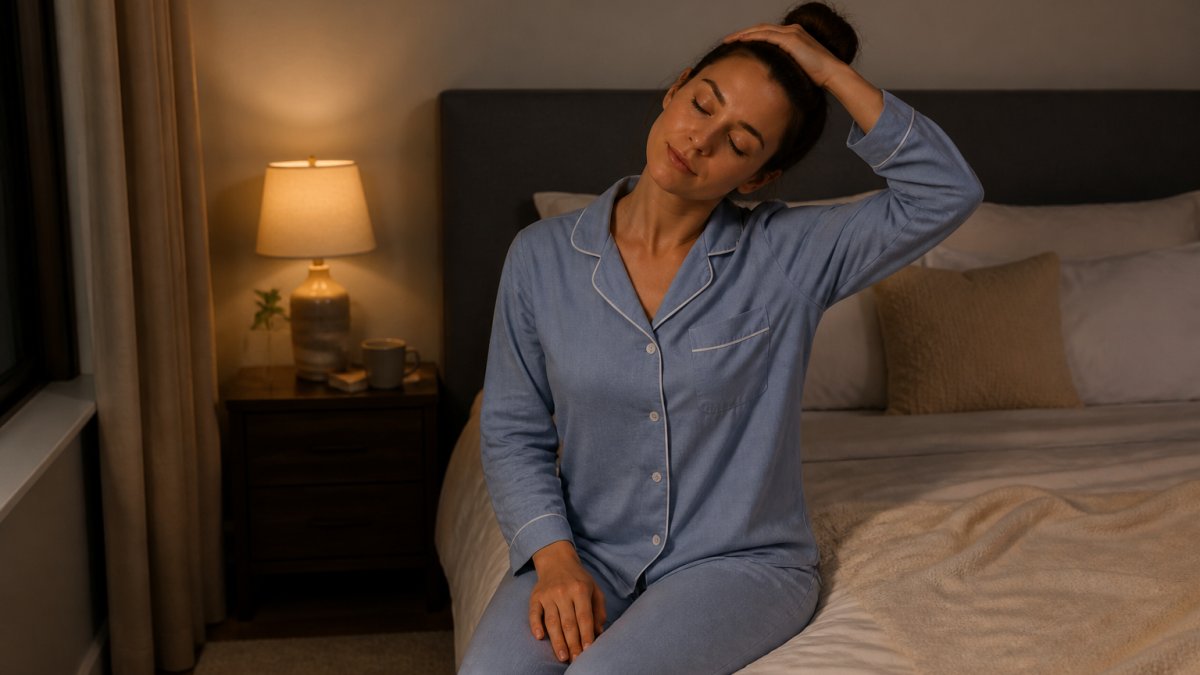
Minutes 1-2: Seated Neck Tilt (Ear to Shoulder)
Sit tall and let your right ear drift toward your right shoulder. Keep your left shoulder down. Hold for 20 to 30 seconds, then switch sides. Repeat twice per side. You should feel a gentle pull along the opposite side of your neck, not a pinch.
Minutes 3-5: Seated Shoulder Rolls and Upper Back Stretch
Roll your shoulders slowly, five times forward and five times back. Then clasp your hands in front of you, round your upper back, and reach forward. Hold for 20 seconds. This opens the shoulder blades and eases the upper back, which carries much of the load from desk work.
Minutes 6-8: Gentle Neck Rotation and Chin Tuck
Turn your head slowly to the right, hold for 10 seconds, then to the left. Next, tuck your chin straight back as if making a double chin. Hold for 5 seconds and repeat 10 times. This simple move counters forward head posture.
Minutes 9-10: Slow Breathing and Final Release
Drop your chin toward your chest and let the back of your neck lengthen. Breathe in for four counts, out for six. Stay here for the final two minutes. Slow breathing tells your nervous system the day is over.
Gentle Neck Stretches in Bed You Can Do Lying Down
If you are already under the covers, you do not need to get up. Lying down removes gravity from the equation, so your neck needs less range of motion to feel the same release, which is exactly why this version works well as the last thing you do before sleep. Run it in this order and keep the whole sequence to about six minutes.
Setup (30 seconds)
- Lie on your back with a pillow under your knees to take the arch out of your lower back
- Let your arms rest at your sides, palms up
- Slide a thin pillow or a rolled towel under your neck only if your chin does not tip upward, if it does, remove it
- Let your jaw hang loose and your tongue rest on the floor of your mouth
1. Lying side bend (60 seconds)
Tip your head toward your right shoulder until you feel a gentle pull on the left side of your neck. Hold for 20 seconds, breathing out slowly. Return to center, then repeat on the left. Two rounds per side. Keep the opposite shoulder heavy against the mattress, do not let it lift to meet your ear.
2. Slow head rotation (60 seconds)
Turn your head to the right as far as is comfortable, pause for 10 seconds, then return through center to the left. Do three slow passes per side. The pause is the point: holding at end range lets the muscle spindle settle instead of snapping back.
3. Chin tuck into the mattress (60 seconds)
Press the back of your head gently into the mattress as if making a double chin, hold for 5 seconds, release. Ten reps. This is the one move in the sequence that directly counters forward head posture, so do not rush it.
4. Shoulder blade squeeze (60 seconds)
With arms at your sides, draw your shoulder blades down and together as if tucking them into your back pockets. Hold for 5 seconds, release. Ten reps. This is what keeps the upper back from re-tightening the neck five minutes after you finish.
5. Supported final release (90 seconds)
Turn onto your back, drop your chin slightly toward your chest, and let the back of your neck lengthen. Breathe in for four counts, out for six. Stay here until the timer ends, then roll into your sleep position.
If any position makes your symptoms worse rather than better, stop and switch to the seated routine above. A stretch that feels like a pull is fine; one that feels like a pinch, a burn, or a shock is not.
How to Relax Shoulders and Neck in Bed With Breathing Cues
Knowing how to relax shoulders and neck in bed comes down to one habit: pairing movement with your breath. Muscles release more when you exhale slowly.
Try this sequence:
- Breathe in through your nose for four counts
- Hold for two counts
- Breathe out through your mouth for six counts
- On each exhale, let your shoulders sink a little deeper
Repeat for five rounds. This pattern slows your heart rate and signals safety to tight muscles. Many people find their neck lets go on the third or fourth exhale, not the first.
Lying Down Neck Stretches for Side and Back Sleepers
Lying down neck stretches should match how you actually sleep. Side sleepers and back sleepers need different angles to keep the spine neutral.
If you sleep on your side:
- Lie on your side with a pillow that fills the gap between your neck and the mattress
- Tilt your chin slightly toward your chest, hold for 15 seconds
- Roll onto the other side and repeat
If you sleep on your back:
- Lie flat and turn your head slowly left, then right
- Add a chin tuck, holding for 5 seconds each time
- Keep a small rolled towel under your neck for light support
The goal is range of motion, not force. A few slow rounds are enough.
Stretches for Neck Pain While Sleeping: Modifications for Different Mobility Levels
Stretches for neck pain while sleeping should scale to your mobility, not the other way around. If the standard routine feels like too much, drop to an easier version. If it feels like nothing, add a little more. Start at the level below what you think you can handle, it is far easier to add a rep tomorrow than to calm an angry neck tonight.

| Mobility Level | Adjustment | Hold Time | Reps |
|---|---|---|---|
| Limited range | Smaller tilt, support head with hand | 10 seconds | 2 per side |
| Moderate | Full ear-to-shoulder tilt | 20-30 seconds | 2-3 per side |
| Good mobility | Add light hand pressure at the end | 30 seconds | 3 per side |
If you cannot turn or tilt your neck comfortably
Skip the rotation and side-bend moves entirely for the first week. Work only on chin tucks and shoulder blade squeezes, which do not require neck range of motion at all. Add rotation back in one direction at a time once a full turn no longer produces a pull.
If you are seated all day and stiff by evening
Do the seated routine earlier in the evening, then repeat only the chin tuck and shoulder blade squeeze in bed. Two short sessions beat one long one for a neck that has been locked in one position for eight hours.
If you are pregnant or sleeping propped up
Use a rolled towel behind the neck instead of a pillow, and keep every hold to 10 seconds. Propped-up sleep positions load the back of the neck differently, so shorter holds with more reps tend to feel better than long static holds.
How to Tell a Stretch From a Warning Sign
This is the part most routines skip, and it is the part that matters most.
A mild stretch feels like a gentle pull along the side or back of the neck. It fades within seconds of releasing the position. It does not travel.
Stop and do not continue if you feel:
- Sharp, stabbing, or electric pain at any point in the movement
- Numbness, tingling, or weakness in an arm or hand
- Pain that shoots into the head, between the shoulder blades, or down the arm
- Dizziness, blurred vision, or nausea during a neck movement
- Symptoms that get worse with each rep instead of easing
When to check with a clinician before stretching at all
- A recent whiplash, fall, or car accident
- Known disc problems, spinal stenosis, or arthritis in the neck
- Pain that wakes you at night or is worse in the morning than at bedtime
- Fever, unexplained weight loss, or a history of cancer alongside new neck pain
- Numbness or weakness that has been getting worse over days rather than better
A common pattern is that people push through the first twinge because they assume stiffness means they need to stretch harder. The opposite is usually true: a neck that is guarding is protecting something, and forcing range on a guarding neck tends to extend the soreness into the next day. If you are unsure whether what you feel is a stretch or a symptom, err on the side of stopping and asking a professional. The American Academy of Orthopaedic Surgeons guidance on neck pain outlines the red flags that warrant an evaluation.
Pillow, Sleep Position, and Setup: Making Your Stretches Last All Night
Stretching loosens your neck. Your pillow decides whether it stays loose until morning. Get the setup wrong and you undo the whole routine by 2 a.m.
Here is what matters:
- Side sleepers: the pillow should fill the gap between your neck and the mattress so your head stays level with your spine
- Back sleepers: a contoured pillow cradles the curve of your neck without pushing your chin up
- Stomach sleepers: this position twists the neck, so it is worth switching if you can
This is where a cervical pillow earns its place. Our Pillow for Neck and Shoulder Pain is built to cradle the head and fill that neck-to-mattress gap, so the release you just earned holds through the night. Side and back sleepers get support from the same contoured shape, and it keeps its height instead of flattening out by morning.

Common Mistakes to Avoid and When Stretching May Not Be Appropriate
Most people stretch too hard and too fast. That is a common mistake, and it is the one that turns relief into soreness.
Watch for these:
- Bouncing or jerking into a stretch instead of holding still
- Stretching cold muscles right after waking
- Holding your breath through the whole stretch
- Skipping the shoulder and upper back entirely
- Using a pillow that goes flat within weeks
A common mistake is buying a pillow on height alone. The gap between your neck and the mattress is what decides support, and that gap changes with your shoulder width and sleep position.
Stretching may not be right for you if you have a recent whiplash injury, a pinched nerve, or pain that runs down your arm. In those cases, talk to a doctor or physical therapist first. For everyone else, slow and gentle wins.
Conclusion: A Simple Progress Check for Better Sleep
Give the routine two weeks before you judge it. Each morning, note three things: how stiff your neck feels on waking, how many times you woke in the night, and whether you needed to fluff your pillow.
A supportive pillow makes that progress stick. Our Neck Support Pillow for Pain Relief is designed to relax overworked muscles and ease the tension that builds from poor daytime posture, and the Orthopedic pillow for neck pain restores natural alignment for side and back sleepers alike. For a fit you can fine-tune, the Cervical Neck Pillow with Water Base lets you add or remove water to match your comfort level.

Frequently Asked Questions
How long should I hold a neck stretch before bed?
Hold each stretch for 20 to 30 seconds, then switch sides. For the timed routine in this article, that means roughly two to three rounds per stretch within each 2-minute block. You should feel a gentle pulling sensation, not sharp pain. If you feel pain, stop immediately. Slow, controlled breathing while you hold helps your muscles release rather than tense up against the stretch.
Can stretching my neck before bed help with tension and sleep quality?
Gentle stretching before bed can reduce muscle tightness and help your neck and shoulder muscles relax, which supports falling asleep more easily. The key is keeping movements slow and staying within a comfortable range of motion. Pairing your stretches with a supportive pillow that keeps your head and neck aligned through the night helps maintain the relief you create before bed.
What is a red flag for neck pain that needs medical attention?
Seek medical attention if neck pain follows an injury, comes with numbness, tingling, or weakness in your arms or hands, or is accompanied by fever, severe headache, or loss of coordination. Pain that wakes you at night or keeps getting worse over days also warrants a doctor's visit. Stretching is not appropriate for these situations, so get evaluated first.
What should I do if my neck hurts more when I stretch?
Stop the stretch right away and rest your neck in a neutral position. Mild soreness after stretching is normal, but pain during a stretch means you pushed too far. Reduce your range of motion, slow your movements, and try again the next day with a gentler approach. If pain persists or returns each time you stretch, talk to a healthcare provider before continuing.
Your neck does not need a harder routine. It needs a gentler one, done consistently, paired with support that holds its shape until morning. Cervinest builds cervical pillows that cradle the head, fill the neck-to-mattress gap, and help you wake without tension. Get started with Cervinest and give your neck the support it needs to recover while you sleep.