
How to Sleep with Neck Pain: 7 Steps for Relief
Table of Contents
- Why You Wake Up With Neck Pain
- Step 1: Choose the Best Pillow for Neck Pain
- Step 2: Match Your Sleep Position to Your Pain
- Step 3: Add a Cervical Roll for Extra Support
- Step 4: Set Up Your Sleep Environment for Alignment
- Step 5: Try Stiff Neck Relief Exercises Before Bed
- Step 6: How to Fix Neck Pain From Sleeping Wrong
- Step 7: Maintain Your Pillow and Track Your Progress
- Frequently Asked Questions
Last Updated: September 13, 2026
Why You Wake Up With Neck Pain
If you sleep with neck pain, it usually means your head and neck spent the night fighting your pillow. When the cervical spine loses its natural curve for hours, muscles stay contracted and joints stiffen. This guide from Cervinest breaks down how to sleep with neck pain in seven steps.
Your cervical spine has a gentle forward curve and needs support that follows it. When you lie down, the gap between your neck and the mattress has to be filled. If it isn't, your head drops into extension or flexion, and the muscles along the back of your neck work all night.
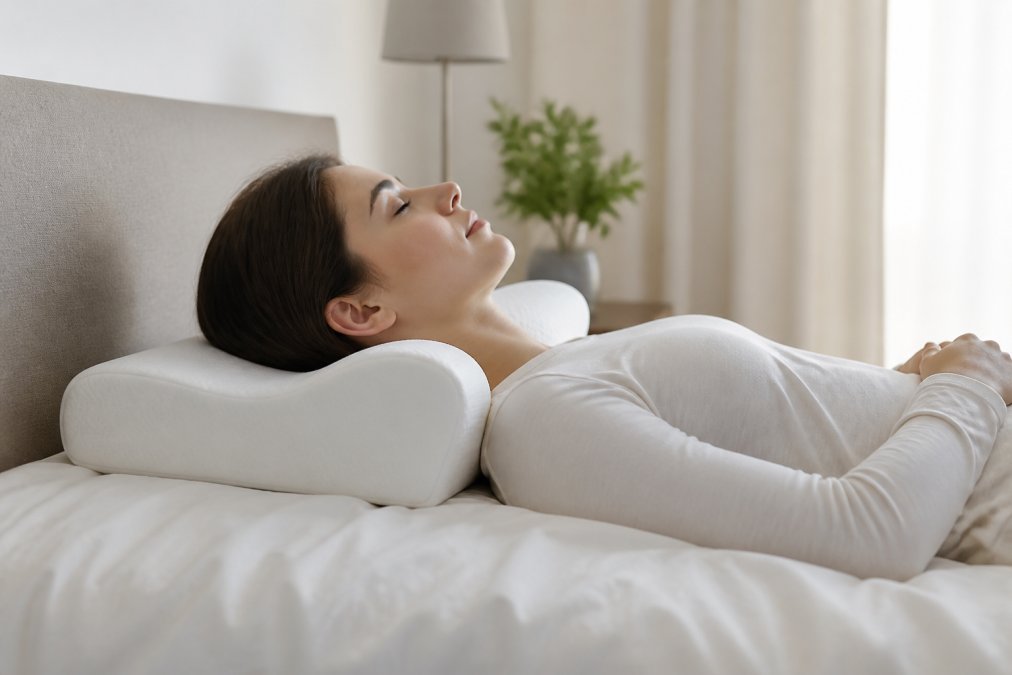
The Role of Cervical Spine Alignment
Cervical spine alignment is the position of the seven vertebrae in your neck relative to each other and to your head. A neutral spine keeps them stacked with their natural curve intact, letting muscles relax instead of guarding against strain.
Three things disrupt that alignment overnight:
- Pillow loft that is too high or too low for your body
- A sleep position that twists or extends the neck
- A mattress that sags under the shoulders
A common mistake is blaming the mattress when the pillow is the real problem. Most people change mattresses before checking whether their pillow fills the neck-to-mattress gap.
Step 1: Choose the Best Pillow for Neck Pain
The best pillow for neck pain fills the gap between your neck and the mattress while keeping your head level with your spine. Contoured cervical pillows cradle the head and support the neck, unlike a standard flat pillow.
"Best" depends entirely on how you sleep: a pillow that works for a back sleeper can push a side sleeper's head into an unnatural angle. Cervinest designs cervical pillows around this principle, with a cradle that holds the head and a contour that supports the neck.
Pillow Loft and Material by Sleep Position
Pillow loft is the height of the pillow when your head rests on it, and it decides whether your neck stays neutral. Match loft to position:
- Back sleepers need a lower loft that supports the cervical curve without lifting the chin
- Side sleepers need a higher loft that fills the distance from shoulder to ear
- Combination sleepers need a pillow that holds its shape when they shift
Material matters too. Material matters too. Down and down-alternative fills compress through the night, which is why so many people wake up flat and sore.
Step 2: Match Your Sleep Position to Your Pain
Your sleep position determines which structures in your neck take the load overnight. Back sleeping is the most forgiving because it keeps the spine neutral. Side sleeping works well if the pillow fills the shoulder gap. Avoid stomach sleeping.
Back Sleeping vs. Side Sleeping
Back sleeping distributes weight evenly and lets the cervical curve rest in its natural shape, but a flat pillow gives no neck support, so back sleepers still need a contoured design.
Side sleeping can be excellent for the neck, but only with the right pillow height. Too low tilts the head down toward the mattress; too high bends the neck the other way. Both create muscle strain.
Stomach sleeping forces the head to rotate 90 degrees and hold that position, working against everything the rest of this article recommends.
| Sleep Position | Pillow Loft | Why It Works | Watch Out For |
|---|---|---|---|
| Back | Low to medium | Supports cervical curve, keeps head level | Pillow too flat leaves neck unsupported |
| Side | Medium to high | Fills shoulder-to-ear gap | Too low tilts head down |
| Stomach | Not recommended | None, rotation strains the neck | Rotated head position all night |
| Combination | Medium, holds shape | Adapts as you shift | Soft fills collapse when you move |
Step 3: Add a Cervical Roll for Extra Support
A cervical roll is a small cylindrical cushion that sits under the curve of your neck, adding targeted support where a flat pillow leaves a gap.
You don't need to buy anything to test it. Roll a bath towel into a cylinder roughly the thickness of your wrist, tuck it inside your pillowcase along the bottom edge, and lie down so it rests under the curve of your neck, not your head. If your neck feels supported rather than pushed, the thickness is right.
Purpose-built cervical pillows build this roll into the design. Cervinest pillows use a contoured shape that cradles the head while the neck rests on a raised section following the cervical curve.
Step 4: Set Up Your Sleep Environment for Alignment
Your pillow is only one part of the setup. The surface beneath it, the bed height, and your pre-sleep habits all decide whether alignment holds through the night.
Start with the mattress. A surface that sags under your shoulders lets your torso sink while your head stays high, bending the neck; one that is too firm keeps the shoulders high and tips the head forward, flattening the cervical curve. The goal is a surface that lets the shoulders settle just enough to keep head, neck, and spine in one line. If your mattress is several years old and shows visible dips, address that before buying more pillows.
Then look at how you lie down:
- Keep your head, neck, and spine in one line when you settle in
- Side sleepers can place a thin pillow between the knees to keep the hips and spine stacked
- Back sleepers can put a small cushion under the knees to take load off the lower back
Bed Height and Getting In and Out
Bed height is the ergonomic factor almost no neck-pain guide mentions. If the mattress sits too low or too high, you brace with your arms and pull with your neck and upper traps every time you get in or out, and that repeated strain adds up.
A practical test: sit on the edge of the bed with your feet flat on the floor. Your knees should be roughly level with your hips. If your feet dangle, the bed is too high; if your knees sit well above your hips, it is too low. A mattress topper or bed riser can correct a few inches without replacing the mattress.
In-Bed Habits That Strain the Neck
Two habits quietly undo a good pillow setup:
- Reading or watching TV in bed with the head propped forward. When you stack pillows behind your head to sit up, the neck is pushed into flexion for as long as you stay there. If you read in bed, sit up against a firm backrest with the book or screen at eye level, not below it, and keep sessions short.
- Scrolling on a phone before sleep. Looking down at a phone in bed loads the cervical spine in the same forward-head position you spend all day trying to avoid, and it delays sleep onset. A common pattern is to hold the phone at chest height and tilt the head down for twenty or thirty minutes. Raise the phone to eye level or put it down before you settle in.
Sleep hygiene plays a role too: a dark, cool room and a consistent bedtime reduce the tossing that pulls your neck out of position, so your neck stays supported longer.
Step 5: Try Stiff Neck Relief Exercises Before Bed
Stiff neck relief exercises before bed loosen muscles that have held tension all day. Five minutes is enough, and the goal is gentle movement, not stretching to the point of pain.
A simple pre-bed routine:
- Slow chin tucks: pull your chin straight back, hold for five seconds, repeat ten times
- Gentle neck rotations: turn your head left and right within a comfortable range, ten times each side
- Shoulder rolls: roll the shoulders back and down, ten repetitions
- Upper trap stretch: tilt your ear toward your shoulder and hold for twenty seconds per side
If you work at a desk all day, these same movements help break up the forward head posture that builds during screen time. A pillow supports your neck at night; movement during the day keeps it from stiffening in the first place. For guidance on posture and neck pain, the American Academy of Orthopaedic Surgeons patient resources are a solid starting point.
Step 6: How to Fix Neck Pain From Sleeping Wrong
Fixing neck pain from sleeping wrong starts with identifying what changed. Most cases trace back to a new pillow, a different sleeping position, or an unusually long night in one spot.
Work through it in order:
- Check your pillow's loft and condition first, since this is the most common culprit
- Review whether you slept in an unfamiliar position, such as on a plane or a hotel bed
- Apply moist heat for fifteen to twenty minutes to relax the muscles
- Keep moving gently rather than holding the neck still all day
- Give it a few days; most sleep-related stiffness eases as the muscle tension releases
If pain radiates into the arm, comes with numbness or weakness, or lasts more than a couple of weeks, that is a reason to see a clinician. Symptoms like those can point to nerve involvement rather than simple muscle strain, and they deserve a proper assessment. The National Institute of Neurological Disorders and Stroke outlines when neck pain warrants medical attention.
Step 7: Maintain Your Pillow and Track Your Progress
A pillow that worked in month one can stop working by month six. Foam compresses, fills clump, and the loft you measured at purchase is not the loft you sleep on a year later. This step decides whether your neck support lasts.
When to Replace a Pillow
There is no single universal replacement date, but the signals are consistent across materials:
- Memory foam and latex: these hold loft longer than fiber fills, but they still break down.
- Down and down-alternative: these compress and shift the fastest. Many people find they need replacement every 12 to 18 months, and some fluffable fills lose meaningful loft in under a year.
- Polyester fiberfill: the least durable option. Expect 6 to 12 months before the fill mats down and stops springing back.
Material choice also interacts with your neck problem. Simple muscle strain is more forgiving, and a softer fill can work if it holds loft.
The Fold Test and the Loft Check
Two quick tests tell you whether a pillow still has life:
- The fold test. Fold the pillow in half. If it springs back to its original shape on its own, the fill still has resilience. If it stays folded or unfolds slowly, the fill has broken down.
- The loft check. Lie down in your usual position and have someone look at your head and neck from the side, or take a photo. Your head should be level with your spine, not tilted up or down. If it is no longer level, the pillow has lost the loft it had when you bought it.
Maintenance basics between replacements:
- Fluff or reshape your pillow each morning
- Wash pillowcases weekly and follow the care label for the pillow itself
- Air out foam pillows rather than washing them, since water breaks down many foams
- Rotate between two pillows if you can, so each one recovers between uses
Track Your Mornings, Not Your Purchases
Tracking turns guesswork into a decision. Note your morning neck stiffness on a 0-to-10 scale for two weeks after any change to your pillow or position, writing it down the same way each morning before you get out of bed.
Read the pattern like this:
- If mornings improve and hold for two weeks, keep the setup.
- If nothing changes after two weeks, adjust the loft or the position before buying anything new.
- If mornings get worse after a change, revert that change first and re-test.
For general sleep health guidance, the Centers for Disease Control and Prevention sleep resources cover the fundamentals of sleep hygiene that support any neck-relief routine.
Frequently Asked Questions
Is it better to sleep with or without a pillow for neck pain?
Sleeping without a pillow leaves your cervical spine unsupported, which lets your head drop backward and strains the neck muscles overnight. A pillow that fills the gap between your neck and the mattress keeps your spine in a neutral position. Back sleepers generally need a lower loft, while side sleepers need a taller pillow to keep the head level with the thoracic spine. If you wake with morning pain, your pillow height is the first thing to check.
How can I tell if my pillow is causing my neck pain?
Three signs point to your pillow: you wake with neck stiffness that eases within an hour, your pillow feels flat or lumpy when you press it, or you find yourself punching and reshaping it during the night. Cervical pillows lose their loft over time, so compare your pillow to a new one every 12 to 18 months. If the pain follows you to a hotel bed with a different pillow, that is a strong clue.
What causes a tweaked neck while sleeping?
Stomach sleeping is the most common cause. It forces your head to rotate 90 degrees for hours, which strains the vertebrae and muscles on one side. A pillow that is too high or too flat does the same thing by pushing your cervical curve out of neutral alignment. Cold drafts, an unsupported arm position, and an old mattress that sags under your shoulders can add to the strain. Fixing sleep posture usually resolves it.
How long does it take to fix neck pain from sleeping wrong?
Most people notice improvement within three to five nights of correcting their pillow height and sleep position. Muscle strain from a single bad night often eases in 24 to 72 hours with gentle stiff neck relief exercises and heat. If pain lasts more than two weeks, radiates into your arm, or comes with numbness or tingling, see a doctor. Those signs can point to cervical radiculopathy, which needs a proper diagnosis.